
AI Phone Call Transcription: Best Tools 2025
Why Businesses Are Turning to AI Phone Call Transcription
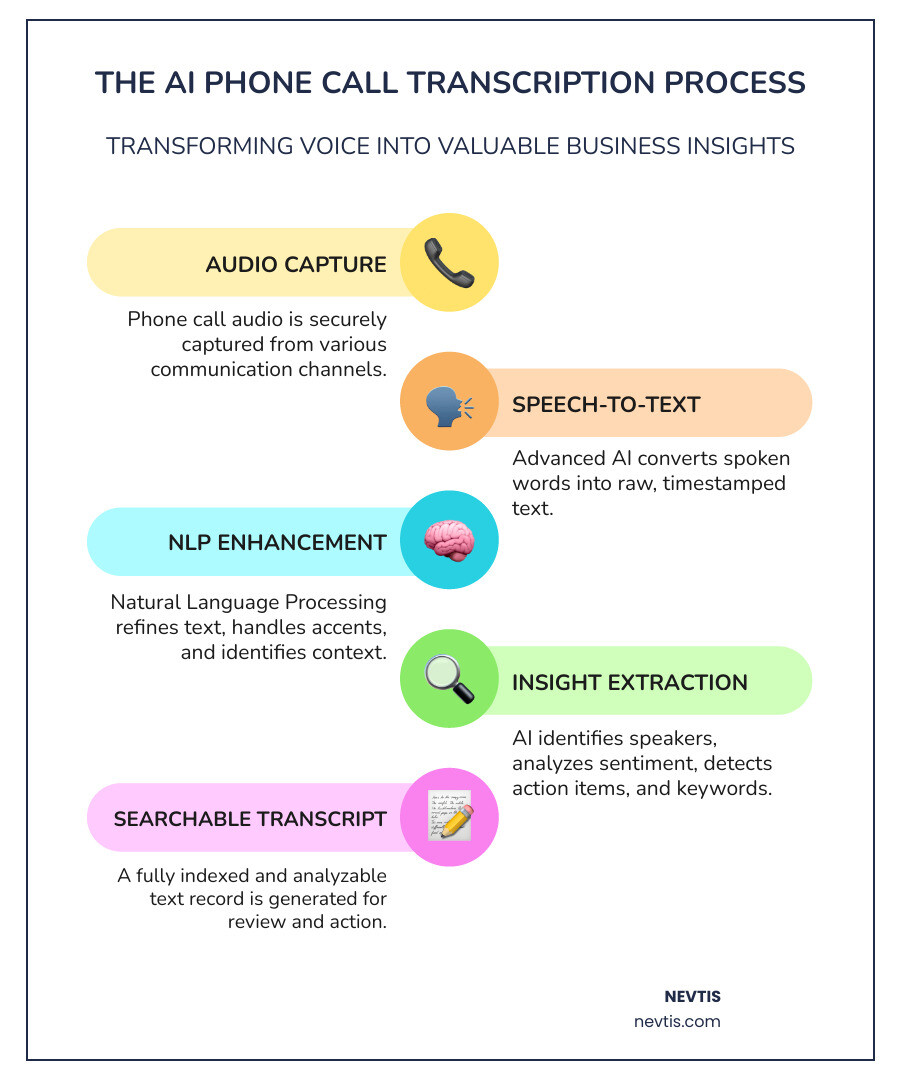
AI phone call transcription uses artificial intelligence to automatically convert your phone conversations into searchable, written text—eliminating manual note-taking and opening up valuable insights hidden in every call.
If you’ve ever tried to balance back-to-back calls while taking notes, you know the struggle. Important details slip through the cracks. Follow-up tasks get forgotten. Customer insights disappear into the void.
The problem isn’t your memory—it’s that humans weren’t designed to actively participate in conversations while simultaneously documenting them.
That’s where AI transcription comes in. Modern speech-to-text technology powered by Natural Language Processing (NLP) can now understand how humans actually speak—handling idioms, accents, cross-talk, and even whispers. The global AI call center market is projected to reach $5.5 billion by 2030, and businesses implementing these tools are seeing operational cost reductions of up to 30%.
But AI transcription isn’t just about saving time. It’s about opening up the treasure trove of insights buried in over 100 billion business calls made annually. Every conversation contains valuable data about customer needs, agent performance, sales opportunities, and compliance risks. Transcription transforms these fleeting moments into permanent, searchable, analyzable records.
I’m Juan Olmedo, and through NEVTIS, I help small businesses implement enterprise-level communication technologies including ai phone call transcription integrated with hosted VoIP systems. My experience coaching contractors and building tech solutions has shown me how the right transcription tools can transform business operations.
Why Your Business Needs AI Phone Call Transcription
You know that sinking feeling when you hang up an important call and realize you can’t remember if the client said Tuesday or Thursday? Or when you promised to follow up on something but didn’t quite catch all the details? We’ve all been there.
Here’s the thing: AI phone call transcription isn’t just about capturing what was said. It’s about fundamentally changing how your team works, how you understand your customers, and how you make decisions that drive growth.
The productivity boost alone is worth it. When your team members aren’t frantically scribbling notes, they can actually be present in the conversation. They can listen for what’s really being said, pick up on emotional cues, and respond with genuine empathy. The documentation happens automatically in the background.
The numbers tell the story: businesses using AI transcription see agent efficiency jump by up to 20%. That’s not about making people work harder—it’s about removing the friction that slows them down. More calls resolved. More problems solved. No additional headcount needed.
Then there’s the financial impact. By automating transcription and call analysis, companies are reducing operational costs by 30%. Think about all those hours that used to go into manual transcription, re-listening to calls to find specific details, or data entry into your CRM. Those hours add up fast. With AI handling the heavy lifting, you can reinvest those savings into actually growing your business.
But the real magic happens when you start mining the data. Every transcribed conversation becomes a searchable asset. You can spot trends across hundreds of calls. You can identify the questions customers ask most often. You can find gaps in your product offering or training needs for your team. This kind of data-driven decision making used to require expensive consultants and months of research. Now it’s built into your everyday operations.
Your customers feel the difference too. When every interaction is documented and searchable, nothing falls through the cracks. Your team can pick up exactly where the last conversation left off. Issues get resolved faster. Customers feel genuinely heard and understood. The result? Customer satisfaction improvements of 15% or more.
At NEVTIS, we’ve built AI transcription directly into our communication platform because we believe every phone call is an opportunity—not just for today’s sale or support issue, but for learning and continuous improvement. To see how we can integrate these capabilities into your existing setup, check out more info about our services.
Real-World Applications Across Industries
The versatility of AI phone call transcription is what makes it so powerful. It’s not just a customer service tool or a sales tool—it transforms how entire organizations operate.
In customer service, transcription creates a complete, searchable history of every customer interaction. Your agents can pull up past conversations in seconds to get context before jumping in. New team members can learn from real examples of how experienced agents handle tough situations. And when sentiment analysis flags that a call is heading south, supervisors can step in before a customer relationship is damaged beyond repair.
Quality assurance and agent coaching get dramatically more effective when you’re not relying on random call sampling. Every conversation can be analyzed for adherence to scripts, use of positive language, and problem-solving approach. Instead of vague feedback like “you need to be more empathetic,” managers can point to specific moments in specific calls and say “here’s where you could have acknowledged the customer’s frustration.” That kind of targeted coaching builds skills fast.
Sales teams get a different kind of advantage. Every client need, every objection, every budget discussion—it’s all captured automatically. The AI can even extract action items and deadlines, so nothing gets forgotten in the rush between calls. When transcripts flow directly into your CRM, sales leaders can review deals without interrupting their reps, spot patterns in what’s working (or not working), and provide coaching based on actual conversations rather than gut feelings.
Legal and financial services face strict compliance requirements around call recording and documentation. AI transcription provides accurate, tamper-proof records that satisfy regulatory requirements while making dispute resolution far simpler. When a client says “but I never agreed to that,” you can pull up the exact transcript and know exactly what was said. For legal professionals, this documentation can literally make or break a case.
Healthcare settings require extra care due to patient privacy requirements, but AI transcription can still streamline documentation when implemented with proper HIPAA-compliant safeguards and PII redaction. Medical professionals can focus on their patients instead of their paperwork, knowing that the conversation details are being captured accurately and securely.
The common thread across all these industries? AI transcription moves communication from something ephemeral—here one moment, gone the next—into a strategic business asset that keeps delivering value long after the call ends.
A Checklist for Choosing the Right AI Transcription Service
Choosing the right ai phone call transcription service can feel a bit like picking the perfect restaurant in a busy city like Los Angeles – there are so many options! But just like finding that ideal spot depends on your taste and needs, the best transcription service for your business aligns perfectly with your operations, budget, and future plans. For businesses across California, from Orange County to Anaheim, it’s about finding a solution that truly fits.
First, let’s think about when you need your calls transcribed. Do you need real-time vs. post-call transcription? Real-time transcription is super helpful for live agent support, giving immediate feedback, or ensuring everyone understands during an ongoing call. Post-call transcription, on the other hand, is great for deep dives, checking quality, or getting summaries after the conversation ends. Many top services offer both, giving you lots of flexibility.
Next up, cost structures. These can vary quite a bit! Some services offer free limited options, while others charge per hour, per user each month, or have custom plans for big businesses. It’s smart to look at how many calls you expect and how many people will use the service to find the most budget-friendly choice. Did you know that NEVTIS often includes ai phone call transcription right within its communication packages? This can be much more affordable than paying for separate tools.
Scalability is also key. As your business grows, your transcription needs will too! Can the service keep up with more calls or users without slowing down or costing a fortune? Look for providers that have flexible plans designed to grow right alongside your business.
And finally, consider API access and how well it integrates with your other tools. A standalone transcription tool is good, but one that talks to your existing CRM, communication apps like Slack, or project management software? That’s a game-changer! This allows for automatic tasks, centralizes your data, and creates a truly connected communication system. Look for built-in integrations or ways to connect your transcription data using tools like Zapier.
Core Transcription Quality
At the very heart of any good ai phone call transcription service is its ability to accurately turn spoken words into text. If the transcript isn’t correct, any insights you gain from it won’t be quite right either, making the whole effort less useful.
We always look for services that boast accuracy rates over 90%. Some of the best even hit amazing accuracy levels, sometimes over 98%! This high level of precision means that important details like names, numbers, and specific terms are captured correctly. While a human transcriber might still catch every tiny nuance, modern AI is incredibly close for most business needs.
Given how diverse California is, multi-language support is often a must-have. Many leading AI transcription services can handle lots of languages – some even support dozens of languages for transcription and translation. This is a huge plus for businesses with global customers or a team that speaks many languages.
It’s also super important for the service to handle different accents and dialect handling well. We all know not everyone speaks the same way! The best AI models are trained on tons of different speech patterns, so they can still understand clearly, even with a bit of background noise or a less-than-perfect accent.
Lastly, for businesses with special vocabulary, custom vocabulary and the ability to understand industry-specific jargon can really boost accuracy. Some services let you “teach” the AI new terms, product names, or acronyms. This ensures your unique business language is correctly transcribed every single time, which is super helpful for technical or specialized fields.
Essential AI-Powered Features for phone call transcription
Beyond simply turning speech into text, the real magic of ai phone call transcription comes from its smart features. These tools turn plain text into valuable insights, making your transcripts a powerful business asset.
- Speaker Identification (Diarization): Imagine a transcript where you know exactly who said what! This feature automatically labels each speaker, making it super easy to follow conversations and see who contributed what. It’s especially useful for calls with multiple people, like team meetings, giving you a clear picture of the discussion.
- Automated Summaries: Who has time to read a 60-minute call transcript? Not you! AI-powered summaries condense long conversations into quick overviews. They highlight the main points, decisions made, and key discussion topics. This saves tons of time for busy pros who just need the gist of a call fast.
- Action Item Detection: This is where AI truly helps you get things done! Smart AI can spot and flag potential tasks mentioned during a call. Whether it’s “send the proposal,” “follow up with John,” or “research X,” the AI can find these tasks. This helps your team stay organized, ensures nothing is missed, and makes your post-call work much smoother.
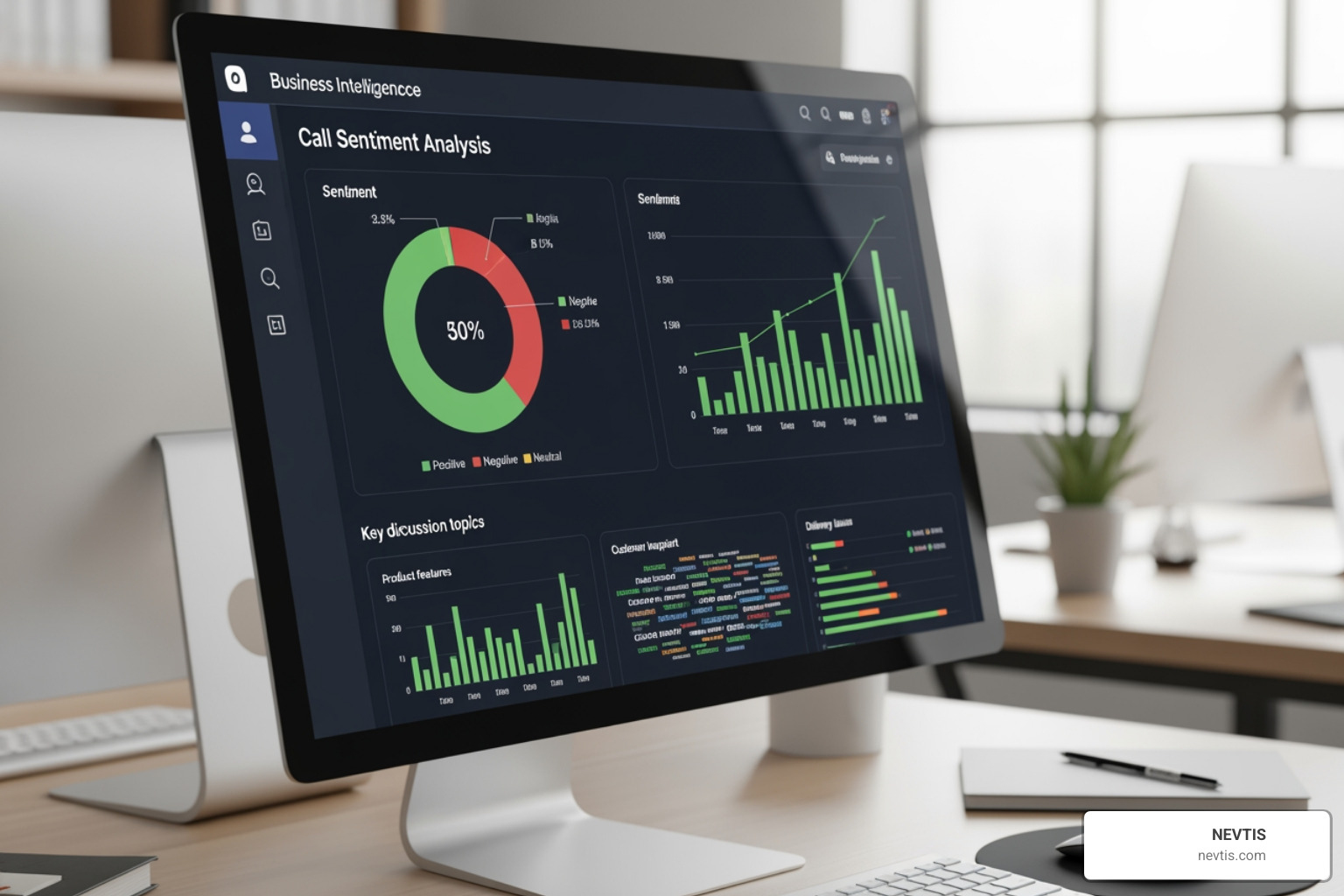
- Sentiment Analysis: Understanding the feeling behind the words can be just as important as the words themselves. Sentiment analysis uses AI to figure out if the tone of a conversation is positive, negative, or neutral. For customer service teams, this is priceless for catching upset customers early, dealing with issues proactively, and training agents on how to handle tough calls.
- Keyword Search Functionality: Once your calls are text, they become fully searchable! This means you can quickly look for specific words, phrases, or topics across all your call transcripts. Need to find every mention of “new project” or a certain client’s name from last month? A good keyword search makes it effortless, letting you find exact information in seconds without re-listening to hours of audio.
These clever features are what make ai phone call transcription an essential tool for modern businesses. They go beyond just documenting to offer proactive insights and improve how efficiently you operate.
Security, Privacy, and Compliance
Keeping our data safe and private is incredibly important. When handling sensitive business calls, especially in regulated industries or with client information, strong security for ai phone call transcription is non-negotiable. For businesses across California, following rules like CCPA isn’t just smart; it’s a legal requirement.
We always look for services that use strong data encryption. This means your call recordings and their transcripts are protected from unwanted access while they’re being sent and while they’re stored. Your conversations are your business, and they deserve the highest level of confidentiality.
Following data protection rules is a must. We make sure the services we recommend are compliant with regulations like GDPR and the California Consumer Privacy Act (CCPA). The CCPA is especially important for businesses here in our state, requiring clear rules and control over personal information. Trustworthy providers will clearly state that your content is only used to transcribe your calls and not to train their AI models, keeping your confidential information safe.
PII (Personally Identifiable Information) redaction capabilities are another crucial feature. Many conversations include sensitive personal data like names, addresses, phone numbers, or credit card details. Advanced ai phone call transcription can automatically spot and remove this information from transcripts, protecting privacy and lowering compliance risks.
Also, user consent management is a vital ethical and legal step. It’s important to make sure everyone on a call knows they’re being recorded and transcribed, and that they’ve given their permission when needed. Some platforms even have built-in alerts or ask for clear consent before recording starts, which follows best practices and legal rules in the United States.
Finally, we stress the importance of secure data storage policies. Look for providers that explain how long your data is kept, where it’s stored, and how it’s eventually deleted. Many good services delete files from their systems quickly (like within 30 days) after transcription, ensuring your data isn’t held onto longer than necessary. For industries like healthcare, specific certifications like HIPAA are critical. Some features, like voicemail-to-text, might even be automatically turned off by providers to meet these strict requirements.
Frequently Asked Questions about AI Transcription
We understand that diving into AI phone call transcription can raise a few questions. It’s a rapidly evolving field, and separating fact from fiction is key to making informed decisions for your business. Here are some of the most common questions we encounter, along with our expert answers.
How accurate is AI transcription compared to human transcription?
This is perhaps the most common question we hear! Historically, human transcription was the gold standard, offering near-perfect accuracy and the ability to pick up on nuances, regional dialects, and specific jargon that AI struggled with. However, human transcription is also significantly slower, more expensive, and less scalable.
Today, AI has closed that gap dramatically. Modern AI phone call transcription services boast accuracy rates often exceeding 90%, with some reaching over 98% under optimal conditions. AI’s advantages include:
- Speed and Scalability: AI can transcribe hours of audio in minutes, making it incredibly fast and scalable for high-volume needs.
- Cost-Effectiveness: It’s significantly cheaper than human transcription, making it accessible for businesses of all sizes, including small and medium-sized businesses across California.
- Efficiency: AI can quickly process vast amounts of data, identifying keywords, sentiments, and action items that would take humans countless hours to extract manually.
While AI is incredibly powerful, human transcription still has its place for specific use cases where 100% accuracy and nuanced understanding are absolutely critical, such as highly sensitive legal proceedings or academic research with complex, overlapping speech. For most business applications, however, AI transcription offers an unbeatable combination of speed, accuracy, and affordability, with a turnaround time that’s virtually instantaneous compared to human services.
What are the limitations of current AI phone call transcription technology?
Despite its impressive advancements, AI phone call transcription isn’t without its limitations. It’s a powerful tool, but it’s not magic (yet!). Understanding these limitations helps us set realistic expectations and implement strategies to mitigate them.
- Background Noise Challenges: While AI models are becoming increasingly resilient, heavy background noise (think a busy coffee shop or a construction site nearby) can still degrade transcription accuracy. Clear audio input remains the best foundation for precise transcription.
- Handling Cross-Talk: When multiple speakers talk over each other, even humans can struggle to decipher every word. AI technology has improved significantly in speaker diarization (identifying who said what), but simultaneous, overlapping speech can still present challenges for perfect transcription.
- Accuracy with Heavy Accents: While many AI services support multiple languages and are trained on diverse speech patterns, very strong or unfamiliar accents can sometimes reduce accuracy. This is where custom vocabulary features can help, as the AI learns to associate specific sounds with specific words.
- Understanding Complex Context: AI is excellent at transcribing words, but truly understanding the deeper context, sarcasm, or highly nuanced discussions can still be a hurdle. This is why features like sentiment analysis are continuously being refined.
- Need for Human Review: For critical applications where absolute accuracy is paramount, a human review or editing pass is often recommended. While AI provides a solid first draft, a quick human check can catch any errors, particularly with proper nouns, industry jargon, or subtle misinterpretations.
We continuously monitor these limitations and advise our clients on how to optimize their call environments and leverage AI features to get the best possible results.
How does AI transcription integrate with other business tools?
The real power of AI phone call transcription is released when it’s integrated seamlessly into your existing business ecosystem. A standalone transcription tool is helpful, but one that “plays nice” with your other software becomes a force multiplier for productivity.
Many leading AI transcription services offer robust native integrations with popular business applications. This means your call transcripts, summaries, and action items can automatically flow into the tools your team already uses daily.
Think about your CRM platforms (Customer Relationship Management). Integrations allow call transcripts and summaries to be automatically logged against client records. Sales teams in Los Angeles can quickly review past interactions, and customer service in Anaheim can pull up a complete history before calling a client back.
For communication tools like Slack, integrations enable transcripts or key highlights to be shared directly with relevant team channels, keeping everyone in the loop without endless meetings or email chains. Similarly, integration with project management software means action items detected during calls can be automatically added to task lists, ensuring accountability and follow-through.
Beyond native integrations, many services support Zapier workflows. Zapier acts as a bridge, connecting thousands of different applications. This means even if there isn’t a direct native integration, you can often create custom automated workflows to send your transcription data wherever it needs to go—from a Google Sheet for analysis to a Notion page for collaborative note-taking.
Furthermore, unified communication platforms, like those we offer at NEVTIS, often have AI call transcription built directly into their systems. This means your phone calls, video meetings, and messaging are all part of a single platform, with transcription and AI insights integrated as core features. This creates a streamlined, efficient workflow that improves communication across your entire organization, whether your team is in a single office in Pasadena or distributed across multiple locations in the United States.
Conclusion: Accept the Future of Business Communication
We’ve journeyed through AI phone call transcription together, and I hope you’re as excited about its potential as I am. This isn’t some distant technology we’ll see “someday”—it’s here now, changing how businesses communicate, make decisions, and serve their customers.
Think about what we’ve covered: teams working 20% more efficiently, operational costs dropping by 30%, customer satisfaction climbing by 15%. These aren’t just numbers on a slide deck—they’re real improvements happening in real businesses, from customer service centers to sales teams to legal offices across California and beyond.
What makes AI phone call transcription truly special is how it transforms something we do every day—talking on the phone—into a strategic advantage. Every conversation becomes a learning opportunity. Every call adds to your knowledge base. Every interaction reveals insights you can act on. It’s like having a brilliant assistant who never forgets a detail, never misses a follow-up, and is always ready to help you understand what your customers really need.
The technology will only get better from here. We’re already seeing AI that can detect sentiment in real-time, automatically flag action items, and summarize hour-long calls in seconds. As these models continue learning and improving, they’ll handle even more complex scenarios, understand more languages and accents, and provide even deeper intelligence about your business conversations.
At NEVTIS, we’ve built AI call transcription directly into our cloud-hosted VoIP phone systems because we know it’s not just a nice-to-have feature—it’s essential. Our NEVTIS Plus mobile app puts over 50 enterprise capabilities right in your pocket, including intelligent transcription that turns every call into searchable, analyzable data. Whether your team is in the office in Los Angeles, working from home in Orange County, or spread across the United States, they’ll have the same powerful tools to communicate effectively and capture every important detail.
We’ve helped countless businesses—from busy contractors to growing customer service teams—make the leap to smarter communication. The change isn’t just about technology; it’s about giving your people the freedom to focus on what they do best while the AI handles the documentation, analysis, and insights.
Don’t let another valuable conversation disappear into thin air. Don’t let your team waste hours on manual note-taking when they could be building relationships and closing deals. The future of business communication is here, and it’s more accessible and affordable than you might think.
Explore our VoIP solutions and find how we can help your business capture every word, every insight, and every opportunity. Let’s transform the way you communicate together.