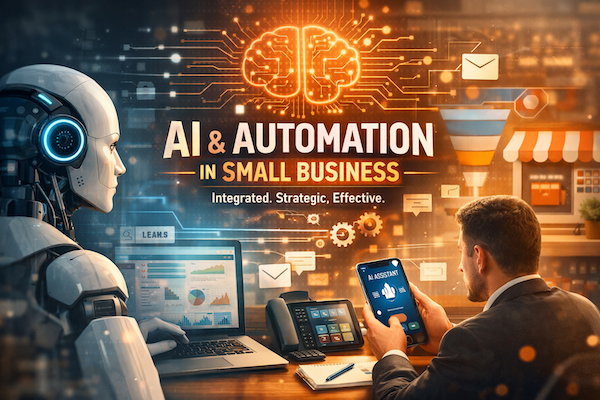
AI + Automation Is Reshaping Small Business — But Only If You Use It Correctly
Every week there’s a new AI tool.
A new automation platform.
A new promise that “this will change your business.”
But here’s the reality:
Most small businesses don’t need more tools.
They need better integration and smarter deployment.
AI isn’t the advantage.
Strategic implementation is.
The Problem: Tool Overload
Small businesses are signing up for:
- AI writing tools
- Automation platforms
- CRM add-ons
- Chatbots
- Call transcription software
- Marketing automation tools
But very few are asking the most important question:
How does this connect to my existing workflow?
Without integration, AI becomes just another app tab.
Where AI Actually Delivers Value
The businesses seeing real gains are using AI in very specific areas:
1. Call Intelligence & Documentation
Instead of relying on memory or handwritten notes, AI-powered call transcription and summarization:
- Reduces follow-up mistakes
- Improves sales tracking
- Protects against miscommunication
- Creates searchable call records
When integrated into your phone system and CRM, this becomes a productivity multiplier.
2. CRM Automation That Drives Revenue
AI inside CRM systems can:
- Identify hot leads faster
- Suggest follow-up timing
- Draft outreach messages
- Track pipeline activity
But only when:
- Calls are logged automatically
- Text messages sync
- Sales workflows are structured
AI amplifies structure. It doesn’t replace it.
3. Customer Responsiveness
Small businesses win on responsiveness.
AI + automation can:
- Route calls intelligently
- Auto-respond to inquiries
- Send appointment confirmations
- Trigger follow-up messages
The result? Faster response times without hiring additional staff.
What Most Small Businesses Get Wrong
They chase features instead of outcomes.
They:
- Add AI without defining the goal
- Buy automation without mapping the process
- Expect software to fix operational gaps
Technology cannot compensate for lack of structure.
It can, however, scale what already works.
The Smart Stack Approach
Instead of stacking disconnected tools, consider this approach:
- Start with communication foundation
- Business phone system
- SMS capability
- Call routing structure
- Integrate with CRM
- Automatic call logging
- Contact syncing
- Sales pipeline tracking
- Layer AI strategically
- Call transcription
- Sales insight summaries
- Follow-up reminders
- Smart routing
- Automate repetitive tasks
- Appointment confirmations
- Lead assignments
- Task reminders
Now AI isn’t random.
It’s embedded into revenue-driving workflows.
Why This Matters in 2026
Small businesses are competing with:
- Larger firms
- Faster marketing cycles
- Shorter customer attention spans
- Higher customer expectations
The businesses that survive and grow are not the ones with the most software.
They are the ones with:
- Clear systems
- Integrated tools
- Fast response times
- Documented workflows
- Data-informed decisions
The Bottom Line
AI is not magic.
Automation is not strategy.
But when integrated correctly into your communication systems, CRM, and operational workflows — they become powerful leverage.
If you’re going to adopt AI this year, don’t start with hype.
Start with your foundation.
Then build from there.
Leave a Reply