Blog

  • Starlink’s Direct-to-Cell Revolution: Satellite Internet on Your Phone, No Strings Attached

    Starlink’s Direct-to-Cell Revolution: Satellite Internet on Your Phone, No Strings Attached

    Starlink’s mobile satellite internet service transforms connectivity by beaming signals directly to unmodified smartphones, eliminating the need for dishes, apps, or hardware upgrades. This Direct-to-Cell (D2C) technology promises lifeline access in remote areas, disaster zones, and coverage dead spots worldwide. As partnerships with carriers like T-Mobile roll out, it signals a shift from fixed broadband to ubiquitous mobile coverage.

    How Direct-to-Cell Works

    Satellites equipped with cellular modems orbit as space-based cell towers, linking to standard LTE and 5G phones with a clear sky view. Users experience seamless handoffs from ground networks—no manual switching or special equipment required. Initial focus lands on essentials like SMS, MMS, 911 calls, and location sharing, with voice and data capabilities scaling up as satellite density grows.​

    This builds on Starlink’s low-Earth orbit constellation, now exceeding thousands of satellites, to minimize latency compared to traditional geostationary options. Phones from the past four years generally support it, auto-connecting outdoors where terrestrial signals fade. Indoor use remains limited, prioritizing open-sky scenarios like hiking trails or rural drives.

    Rollout Milestones and Partnerships

    T-Mobile’s beta launched early 2025, amassing 1.8 million users and over a million messages before the full US debut in July 2025. Pricing integrates into existing plans: free for premium tiers ($17+ monthly per multi-line), or $10/month add-on, extending to AT&T and Verizon customers too.

    Global expansion accelerates with carriers like Australia’s Optus and Japan’s KDDI testing integrations, targeting underserved regions. SpaceX plans third-generation satellites by mid-2026, boasting 1Tbps downlink capacity per bird to boost speeds and reliability. Recent updates highlight 2 million active US customers achieving near-200Mbps median downloads during peaks, underscoring network maturity.

    Real-World Capabilities and Limitations

    For everyday users, D2C excels in basics: reliable texting during blackouts, SOS alerts for emergencies, and navigation in off-grid spots. Early adopters report success in rural America, maritime voyages, and wildfire evacuations—scenarios where ground infrastructure fails. Data throughput starts modest, akin to 2G/3G edges, but evolves toward broadband as more satellites launch and beamforming tech refines signals.

    Challenges persist: signals weaken under tree cover or buildings, and high-speed data demands clear horizons. It’s not a home internet rival but a gap-filler for mobiles, complementing Starlink’s dish-based residential service. Battery drain stays minimal since phones treat it like any carrier handover.

    Broader Impacts on Connectivity and Society

    This launch erodes digital divides, empowering remote workers, adventurers, and disaster responders with always-on access. In the US, it bolsters rural economies by enabling telemedicine, online education, and e-commerce without fixed lines. Globally, it aids developing nations leapfrogging infrastructure hurdles.

    Economically, Starlink fuels SpaceX growth, with analysts eyeing direct-to-device as a multi-billion revenue stream by 2027. Rivals like Apple’s emergency satellite feature or AST SpaceMobile chase similar tech, spurring competition. Environmentally, denser satellite fleets raise light pollution concerns, though SpaceX mitigates with anti-reflective coatings.

    Future Roadmap and What to Watch

    By late 2026, expect voice calls and streaming-viable data as V3 satellites deploy via Starship reusables, slashing costs. Starlink explores a “Starlink Phone” for optimized integration, though unmodified devices remain the focus. Regulatory nods in Europe and Asia pave international scaling, potentially covering 100% of oceans and poles.

    For users, monitor carrier announcements—beta waitlists fill fast. Test it on your next road trip: step outside, and your phone might just connect from space. Starlink’s D2C doesn’t just launch a service; it redefines mobility in a connected world


  • Beyond the Cell Tower: How Direct-to-Device Satellite Connectivity is Redefining Global Communication

    Beyond the Cell Tower: How Direct-to-Device Satellite Connectivity is Redefining Global Communication

    Imagine standing in the most remote corner of a vast mountain range, staring at a screen that displays zero bars of signal, yet successfully sending a message that reaches your family instantly. This scenario, once reserved for those carrying bulky and expensive specialized hardware, is rapidly becoming the new standard for consumer smartphones. As the telecommunications industry pivots toward the sky, the convergence of terrestrial mobile networks and non-terrestrial networks (NTN) marks one of the most profound shifts in connectivity history.


    The Dawn of the Sky-High Network

    For decades, the fundamental limitation of mobile technology has been geography. Cell towers require power, land, and fiber backhaul, making them economically unfeasible in sparsely populated areas, oceans, and rugged terrains. Consequently, a significant portion of the Earth’s surface has remained a digital dead zone. However, the latest trend in telecommunications technology—Direct-to-Device (D2D) satellite connectivity—is dismantling these physical barriers. By allowing standard smartphones to communicate directly with Low Earth Orbit (LEO) satellites, the industry is effectively turning the sky into the ultimate cell tower.


    This technology operates differently from the legacy satellite phones of the past, which relied on high-orbit Geostationary (GEO) satellites. Those older systems required large antennas and had significant latency. The current revolution utilizes LEO constellations, which orbit much closer to Earth (often between 500 and 2,000 kilometers). This proximity reduces signal lag and allows the compact antennas already inside modern smartphones to establish a link, provided there is a clear view of the sky. It is a seamless integration of hardware and software that promises ubiquitous coverage.


    A smartphone in a remote mountain landscape, connected to a satellite

    Understanding the Technology: 5G NTN

    At the heart of this transformation is the 3GPP Release 17 standard, which officially introduced Non-Terrestrial Networks (NTN) into the 5G ecosystem. This standardization is crucial because it moves the industry away from proprietary, walled-garden solutions toward a unified framework where any compliant device can roam onto satellite networks. This works much like international roaming does today, but instead of switching from AT&T to Vodafone, your phone switches from a terrestrial tower to a satellite passing overhead.


    The technical implications are vast. Mobile Network Operators (MNOs) are now partnering with satellite providers to extend their coverage maps instantly. For the end-user, this means that the concept of “out of service” is slowly becoming obsolete. Initially starting with emergency SOS features, the roadmap for this technology is rapidly expanding to include two-way SMS, messaging apps, and eventually, voice and low-bandwidth data services.


    The Global Impact and Market Reality

    The drive for satellite integration is not merely a luxury for adventure travelers; it is a necessity for bridging the digital divide. According to recent data from the GSMA, while mobile broadband coverage is extensive, approximately 5% of the global population still lives in areas not covered by a mobile broadband network. While this percentage seems small, it represents hundreds of millions of people, primarily in rural and developing regions, who are entirely cut off from the digital economy.


    Furthermore, the economic incentive for this technological leap is undeniable. A report by ABI Research projects that the satellite-to-mobile market could reach 6.8 million monthly active users by 2027, indicating a massive consumer appetite for guaranteed connectivity. This growth trajectory suggests that satellite capability will soon be a standard feature in flagship and mid-range devices, rather than a niche selling point.


    Practical Applications Beyond Emergencies

    While the marketing for D2D connectivity often focuses on dramatic rescue stories, the practical applications are far broader. For logistics and supply chain management, this technology ensures that assets moving across oceans or deserts are always trackable. For the agricultural sector, IoT sensors in remote fields can transmit data regarding soil moisture and crop health without the need for expensive local infrastructure.


    In the realm of personal use, this shift changes how we plan travel and remote work. Digital nomads, who were previously tethered to locations with reliable Wi-Fi or 4G, can now venture further off the grid while maintaining a lifeline to their clients and teams. It democratizes the freedom of movement, ensuring that safety and communication are not compromised by the desire for exploration.


    Navigating the Transition: Practical Tips

    As we transition into this new era of hybrid connectivity, users must understand how to optimize their devices for satellite communication. Unlike cellular signals which can penetrate glass and thin walls, satellite connections are more fragile and demand specific conditions. Here are three practical tips to ensure you are ready to utilize this technology:


      • Prioritize Line of Sight: Satellite signals operate on high frequencies that are easily blocked by obstructions. If you need to connect, move to an open area away from tall buildings, dense tree canopies, or deep canyons. Your phone needs to “see” the satellite to talk to it.


      • Manage Battery Consumption: Searching for a satellite signal consumes significantly more power than connecting to a nearby cell tower. If you are in a dead zone, turn off the satellite search feature until you actually need to send a message to preserve your battery life for emergencies.


    • Update Firmware Regularly: Because this technology is in its infancy, manufacturers are frequently releasing updates to improve connection stability and satellite handover protocols. ensuring your device is running the latest software is critical for functionality.


    Reflecting on a Connected Future

    The integration of satellite technology into our mobile devices serves as a powerful reminder of human ingenuity. We are no longer limited by the infrastructure we can build on the ground; we are looking upward to solve the problems of the earth. This technological evolution forces us to reflect on what it means to be truly connected. It offers a safety net for the adventurous and a bridge for the isolated.


    However, with this ubiquity comes the responsibility of balance. Just because we can be reached anywhere, does not always mean we should be. As we embrace this era of total connectivity, we must also learn the art of intentional disconnection, using these tools to enhance our lives rather than dictate them.


    Join the Conversation

    The future of telecommunications is being written right now, and it is happening in the orbit above us. As this technology becomes accessible to the mainstream, it will undoubtedly shape how we work, travel, and stay safe. We invite you to stay curious, keep exploring the boundaries of technology, and become part of this growing community of tech enthusiasts who are watching the skies for the next big breakthrough.

  • Microsoft Azure Outage: Why Businesses Crashed and Why Calm Prevails Now

    Microsoft Azure Outage: Why Businesses Crashed and Why Calm Prevails Now

    A widespread Microsoft Azure outage hit on January 22, 2026, knocking out services globally for over nine hours and paralyzing business operations. Routine North American maintenance spiraled into capacity overloads, disrupting Microsoft 365, Outlook, Teams, and Azure-dependent platforms. Full recovery arrived swiftly, restoring normalcy by early January 23 with no lingering disruptions.

    Detailed Timeline of the Disruption

    The outage kicked off around 11:40 a.m. PST (2:40 p.m. EST), with user reports flooding in about connectivity timeouts and service errors. Azure’s North American servers buckled under elevated traffic, possibly exacerbated by third-party networking glitches, creating widespread imbalances. By late afternoon EST, Microsoft 365 apps like Outlook saw email failures, Teams chats stalled, and tools such as Copilot, Defender, and Purview became unresponsive.

    Recovery efforts ramped up unevenly into the evening. Microsoft applied load balancing fixes and traffic rerouting, but full restoration dragged until about 1:30 a.m. EST on January 23. This came just a day after a separate Microsoft 365 hiccup on January 21, underscoring recurring pressures on the infrastructure. No major data loss surfaced, but the nine-hour span tested contingency plans everywhere from enterprises to remote workers.

    Services Hit Hardest and Real-World Fallout

    Azure’s core faced the brunt, with portal access, API calls, and storage operations grinding to halts. Microsoft 365 users grappled with Outlook send/receive blocks, Teams meeting drops, and admin center lockouts. Security tools like Defender lagged, while consumer-facing services including the Microsoft Store flickered intermittently.

    Globally, impacts rippled from US enterprises to users in Europe, Asia, and Latin America—including Colombia—where time zone overlaps amplified frustration during peak hours. Developers paused deployments, e-commerce sites faltered, and hybrid work setups crumbled, costing productivity estimated in millions. The event echoed past Azure incidents, like those in 2025, reminding everyone of single points of failure in cloud ecosystems.

    Root Causes and Microsoft’s Response

    At its core, a maintenance-induced load spike overwhelmed server capacity, leading to cascading failures in traffic processing. While Microsoft pinned it on internal infrastructure without naming culprits like BGP routing or DDoS, the lack of an early ETA drew criticism for slow communication. Teams worked through the night on mitigations, eventually stabilizing services without long-term damage.

    This outage fits a pattern: Azure’s growth strains its backbone, especially post-2025 expansions in AI workloads and edge computing. Microsoft promised post-mortems and updates via their status page, but users crave deeper transparency on redundancies.

    Lessons for Businesses and Users

    Cloud reliance demands backups. The outage exposed gaps in multi-region setups—many stuck to single Azure zones, amplifying downtime. Hybrid clouds with AWS or Google Cloud proved more resilient, as did offline-first apps. Enterprises should audit SLAs; Azure’s 99.99% uptime pledge bent but didn’t fully break here.

    For developers, caching strategies and API retries mitigated some pain, yet full outages test even robust code. Small businesses, hit hardest without IT armies, learned the value of diversified tools over all-in Azure bets.

    Call to Action: Build Your Resilience Now

    Don’t wait for the next outage—secure your operations today. Audit your Azure dependencies with Microsoft’s status dashboard at azure.status.microsoft and enable multi-region failover. Test backup providers like AWS or on-prem alternatives, and drill your team on offline workflows. Share your outage stories in the comments: How did you cope? What tools saved you? Act now to turn vulnerability into strength—your business will thank you when the cloud blinks again.

  • Bridging the Blue and Green Divide: How RCS is Revolutionizing Mobile Messaging

    Bridging the Blue and Green Divide: How RCS is Revolutionizing Mobile Messaging

    For over a decade, a subtle yet pervasive divide has existed in the world of mobile communication, often color-coded in green and blue bubbles. With the recent universal adoption of Rich Communication Services (RCS) across major mobile operating systems, this technological fragmentation is finally dissolving. We are witnessing a historic standardization that prioritizes the human need for seamless connection above proprietary ecosystems.


    The telecommunications landscape is undergoing a significant transformation. For years, Short Message Service (SMS) and Multimedia Messaging Service (MMS) served as the backbone of carrier-based text messaging. While revolutionary in the 1990s and early 2000s, these protocols have long been outdated, struggling to support the high-fidelity media and real-time interactivity that modern users demand. The introduction of proprietary instant messaging apps filled this void, but they created walled gardens that segregated users based on their device preferences. The recent move to standardize RCS on both Android and iOS devices marks the end of this segregation, ushering in a new era of interoperability.


    The Evolution from SMS to the Universal Profile

    To understand the magnitude of this shift, one must look at the technical limitations of what came before. SMS was restricted to 160 characters and relied on cellular voice networks to transmit data. MMS allowed for images and video, but with severe compression limits that often rendered shared memories into pixelated blurs when sent between different operating systems. These legacy protocols lacked awareness of the recipient’s status; you never knew if a message was delivered, let alone read, or if the other person was currently typing a response.


    RCS, specifically the Universal Profile developed by the GSMA (Global System for Mobile Communications Association), changes the architecture of carrier messaging. Unlike SMS, RCS operates over data networks (Wi-Fi or LTE/5G). This fundamental change allows it to carry much heavier payloads and support persistent connections. It brings features previously reserved for apps like WhatsApp or iMessage—such as high-resolution photo sharing, large file transfers, group chat management, and read receipts—directly into the native messaging app of the smartphone. This is not just an app update; it is a fundamental upgrade to the telecommunications infrastructure itself.


    Breaking Down the Digital Walls

    The most culturally significant aspect of the RCS revolution is the dissolution of the social friction caused by device incompatibility. For years, group chats containing a mix of operating systems were notorious for breaking features. If one user was on a different platform, the entire group experience degraded to the lowest common denominator: SMS/MMS. Reactions to messages would appear as clunky text descriptions (e.g., “Loved an image”) rather than graphical icons, and videos were virtually unwatchable.


    A high-end, photorealistic editorial photograph depicting the unification of different mobile messaging platforms, represented by intertwining blue and green communication bubbles seamlessly merging, symbolizing Rich Communication Services (RCS) bridging the divide between different mobile operating systems, set against a modern, clean digital background.

    With the widespread integration of RCS, these barriers are removed. A video of a child’s first steps or a high-definition travel photo now retains its clarity regardless of the sender’s or receiver’s device. This shift is substantiated by massive adoption numbers. According to recent data released by the GSMA in late 2024, there are now over 1.2 billion monthly active users utilizing RCS messaging globally, a figure that has surged following the protocol’s adoption by major North American smartphone manufacturers. Furthermore, market research indicates that prior to this integration, nearly 40% of smartphone users reported frustration with cross-platform messaging limitations, highlighting the consumer demand driving this change.


    RCS Business Messaging: A New Frontier

    While the consumer benefits are obvious, the implications for business-to-consumer (B2C) communication are equally profound. RCS Business Messaging (RBM) elevates the standard promotional text from a simple string of characters to an interactive, branded experience. In the past, verifying the authenticity of a business SMS was difficult, leading to security concerns regarding phishing and spam. RCS introduces verified sender profiles, complete with brand logos and checkmarks, instilling greater trust in the recipient.


    Beyond security, RBM allows for “rich cards” and carousels. An airline, for example, can send a boarding pass that updates in real-time, complete with a terminal map and buttons to change seats, all within the native messaging app. A logistics company can provide a package delivery interface where the user can reschedule a drop-off without ever clicking a link to open a web browser. This capability transforms the native message inbox from a notification center into a dynamic platform for commerce and customer service.


    Security and Privacy Considerations

    As we embrace this new standard, it is crucial to discuss security. While RCS is a massive improvement over SMS (which sends messages in plain text), the implementation of encryption can vary. Many implementations use client-to-server encryption, which secures the message in transit. However, End-to-End Encryption (E2EE)—where only the sender and recipient can read the message—is not inherent to the basic RCS Universal Profile but is rather an addition implemented by specific providers. As the technology matures, achieving a standardized, cross-platform E2EE remains the final frontier to ensure that privacy in carrier messaging matches the high standards set by niche secure messaging applications.


    Practical Tips for Maximizing Your RCS Experience

    To ensure you are getting the most out of this modern communication standard, consider the following practical steps to optimize your device settings:


    • Verify Carrier Services are Updated: RCS functionality is often tied to carrier services running in the background of your operating system. Ensure your device’s system apps and carrier configuration files are up to date via your settings menu or app store to prevent connectivity issues.
    • Manage Your Read Receipts and Typing Indicators: While transparency is great, privacy is personal. distinct from SMS, RCS allows granular control. Navigate to your messaging app’s settings to toggle “Send Read Receipts” or “Show Typing Indicators” on or off depending on your comfort level with immediate availability.
    • Enable “Send as SMS” Fallback: Data connections can be spotty in remote areas. Ensure your settings are configured to automatically “Fallback to SMS/MMS” if RCS is unavailable. This ensures your urgent messages are still delivered via the cellular voice network if you lose data connectivity.


    The Future of Connectivity

    The adoption of RCS is more than a technical specification; it is a reflection of a maturing digital society. We are moving away from improved technology serving as a wedge to lock users into specific hardware and toward technology serving as a bridge. The focus has shifted to the quality of the conversation rather than the color of the bubble it arrives in.


    As 5G networks continue to expand, providing the low latency and high bandwidth that rich messaging requires, we can expect RCS to evolve further. We may soon see augmented reality integrations or real-time language translation directly within our native message threads. The groundwork has been laid for a communication ecosystem that is inclusive, high-fidelity, and user-centric.


    This evolution invites us to rethink how we connect. It serves as a reminder that technology is at its best when it removes friction and brings us closer together. As we settle into this new standard, take a moment to appreciate the clarity of that next video you receive, the security of that verified business notification, and the seamlessness of your group chats. We invite you to explore these settings on your own devices and join the growing community of users advocating for open, interoperable, and high-quality digital communication standards.

  • The Invisible Revolution: How eSIM Technology is Redefining Global Connectivity

    The Invisible Revolution: How eSIM Technology is Redefining Global Connectivity

    Imagine landing in a foreign country and connecting to a high-speed local network instantly, without ever hunting for a kiosk or fumbling with a paperclip to swap tiny plastic chips. This seamless experience is no longer a futuristic dream but a tangible reality driven by the rapid adoption of eSIM technology. We are currently witnessing the end of the physical SIM card era and the dawn of purely digital connectivity, a shift that promises to liberate mobile users from physical constraints.

    The Evolution from Physical to Digital

    For over three decades, the Subscriber Identity Module (SIM) has been the gatekeeper of mobile connectivity. It began as a credit-card-sized peripheral in the early 1990s, shrinking over time to the mini, micro, and finally, the nano-SIM. However, despite the reduction in size, the fundamental concept remained the same: a physical token was required to authenticate a user on a network. This physical dependency created friction, logistical waste, and limitations on device design.

    The eSIM, or embedded SIM, fundamentally changes this architecture. It is not a card you insert, but a microscopic chip soldered directly onto the device’s motherboard during manufacturing. Technically known as an eUICC (Embedded Universal Integrated Circuit Card), this chip allows users to download and store multiple carrier profiles digitally. The implications of this shift are profound, moving the power of connectivity from a piece of plastic into the software layer of the device.

    This transition is not merely about convenience; it is a necessary evolution for the telecommunications industry. As devices become more compact and hermetically sealed for water and dust resistance, every millimeter of internal space becomes valuable real estate. By removing the physical SIM tray, manufacturers can utilize that space for larger batteries, improved cooling systems, or additional sensors. Furthermore, the removal of the physical slot eliminates a common point of mechanical failure and water ingress.

    Empowering the Modern Traveler and Digital Nomad

    Perhaps the most immediate impact of eSIM technology is felt by the global traveler. In the past, avoiding exorbitant roaming charges meant purchasing a local prepaid SIM card upon arrival. This process often involved language barriers, currency exchanges, and the anxiety of potentially losing your primary home SIM card during the swap. Today, marketplaces for travel connectivity allow users to browse, purchase, and install data plans for over 190 countries before they even leave their homes.

    This capability fosters a new level of freedom for digital nomads and business professionals. A user can maintain their primary home number for calls and SMS authentication (such as banking 2FA) while simultaneously running a local data plan on the eSIM to navigate maps and attend video calls. The ability to toggle between profiles instantly transforms the mobile phone into a truly global tool, stripping away the borders that traditional telecommunications infrastructure often inadvertently enforces.

    Security and Environmental Impact

    Beyond convenience, eSIM technology introduces significant security advantages. A traditional SIM card can be easily removed from a stolen phone, preventing the owner from calling it or tracking it via cellular data. In contrast, an eSIM cannot be physically removed. If a device is stolen, the connectivity remains active, increasing the likelihood of tracking the device successfully. Additionally, the profile is protected by the device’s screen lock, meaning a thief cannot simply put the SIM in another phone to intercept calls or messages.

    From an environmental perspective, the shift is equally compelling. The production, packaging, and shipping of billions of plastic SIM cards annually generate significant waste. This includes the plastic of the card itself, the larger card holder it arrives in, paper manuals, and the carbon footprint associated with global logistics. A transition to digital provisioning significantly reduces this plastic waste and lowers the carbon emissions of the telecommunications supply chain.Digital illustration of a smartphone connecting to a global network via eSIM technology

    Data-Driven Market Shifts

    The adoption of this technology is accelerating at a breakneck pace, driven by consumer demand and manufacturer support. The ecosystem is rapidly maturing, moving from a niche feature in flagship phones to a standard expectation across mid-range devices, wearables, and laptops.

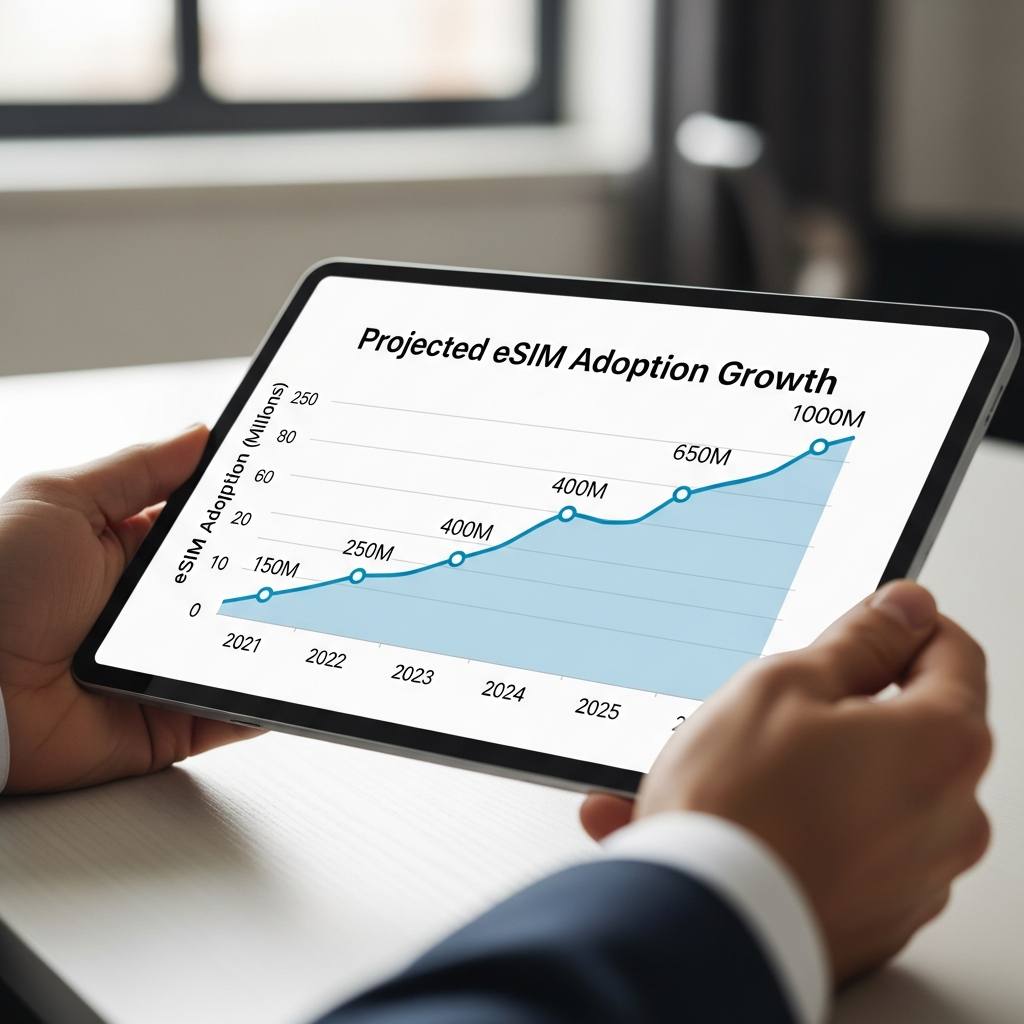
    Recent data underscores this massive growth trajectory. According to Juniper Research, the global number of eSIMs installed in connected devices will increase from approximately 1.2 billion in 2021 to over 3.4 billion by 2025, representing a growth of 180%. Furthermore, GSMA Intelligence reports that by 2025, 60% of all smartphone unit sales are expected to be eSIM-compatible, signaling a tipping point where digital-only devices may soon become the norm.

    Graph showing the projected growth of eSIM adoption from 2021 to 2025

    Practical Guide to Switching to eSIM

    For those ready to embrace this technology, the transition is smoother than many anticipate. However, it does require a basic understanding of how your specific device handles carrier profiles. Whether you are switching your main line or adding a secondary travel line, the process is generally managed through your phone’s settings menu rather than a physical interaction.

    Here are three practical tips to ensure a smooth experience when adopting eSIM technology:

    • Verify Carrier Locking Status: Before purchasing a third-party travel eSIM or attempting to switch carriers, ensure your device is “unlocked.” Many carriers lock phones bought on payment plans to their specific network. An eSIM from a different provider will not install successfully on a locked device. You can usually check this in the “About” section of your phone settings under “Carrier Lock” or “SIM Restrictions.”
    • Label Your Lines Correctly: When you have multiple profiles installed (e.g., “Primary,” “Work,” “Japan Trip”), your phone will ask you to label them. Take the time to do this clearly. You must also designate which line is for voice/SMS and which is for cellular data. For travelers, the golden rule is: Primary line for Voice/SMS (roaming off), Travel eSIM for Data (roaming on).
    • Save Your QR Codes: Most eSIMs are activated by scanning a QR code provided by the carrier. While the profile is digital, the activation key is crucial. If you accidentally delete the eSIM profile from your settings, you often cannot simply “undelete” it; you may need to scan the original QR code again or contact customer support for a new one. Keep screenshots or emails of these codes safe until the plan is expired.

    The Future of Connection

    As we look toward the future, the implications of eSIM extend far beyond mobile phones. This technology is the cornerstone of the Internet of Things (IoT). It enables smart cars to update firmware over the air anywhere in the world, allows smartwatches to stream music without a tethered phone, and permits logistics trackers to monitor global shipments seamlessly. The “always-on” capability is becoming a standard utility, much like electricity.

    The telecommunications industry is often criticized for being slow to adapt, but the eSIM revolution proves that when technology solves real human friction, adoption is inevitable. We are moving toward a world where connectivity is invisible, instantaneous, and intelligent. The friction of the past is melting away, leaving us with pure connection.

    As you consider your next device upgrade or your next international trip, reflect on the freedom that digital connectivity offers. It is more than just a tech spec; it is a tool for a borderless lifestyle. We invite you to stay curious, explore the settings on your own devices, and join the community of forward-thinkers who are embracing this wireless future.

  • Bridging the Digital Divide: The Global Impact of RCS Integration on iOS 18

    Bridging the Digital Divide: The Global Impact of RCS Integration on iOS 18

    For over a decade, the mobile messaging landscape has been fragmented by a distinctive color war between blue and green bubbles, creating social friction and technical limitations for users worldwide. With the landmark integration of Rich Communication Services (RCS) into iOS 18, the telecommunications industry is finally dismantling these walls to create a unified messaging standard. This pivotal shift promises to modernize cross-platform communication, ensuring that clarity and connection are no longer dictated by the device in your pocket.

    The Evolution of Mobile Messaging Standards

    To understand the magnitude of the current shift toward RCS, one must look back at the origins of mobile text messaging. Short Message Service (SMS) was defined in the 1980s and became the backbone of mobile communication in the 1990s. While revolutionary at the time, SMS was severely limited by a 160-character cap and a lack of support for rich media. Multimedia Messaging Service (MMS) followed, allowing for grainy images and low-quality video, but it remained prone to compression artifacts and delivery failures.

    As smartphones evolved, proprietary messaging apps like WhatsApp, Telegram, and Apple’s iMessage filled the void left by outdated carrier standards. They offered high-resolution photos, read receipts, and typing indicators. However, these features were locked within specific ecosystems or required third-party applications. This created a fractured experience where an iPhone user messaging an Android user was forced back into the archaic SMS/MMS protocol, resulting in pixelated videos and broken group chats. The adoption of RCS by Apple in late 2024 marks the first time in history that the native messaging apps of the world’s two dominant mobile operating systems speak the same modern language.

    Understanding Rich Communication Services (RCS)

    RCS is often described as the next generation of SMS. Developed under the guidance of the GSM Association (GSMA), it is an open standard designed to bring the features of modern instant messaging apps directly to the default texting app on your phone. Unlike iMessage, which routes messages through Apple’s proprietary servers, RCS operates through the carrier’s data network, adhering to the Universal Profile standard. This ensures interoperability across different networks and device manufacturers.

    The technical benefits of this transition are immediate and tangible for the average user. When devices utilizing the RCS Universal Profile communicate, images retain their original quality, and videos are no longer compressed into unwatchable thumbnails. Furthermore, the protocol supports Wi-Fi messaging, meaning users can stay connected even when they do not have cellular signal, provided they have internet access. This reliability is a significant upgrade from the dependency on cellular voice channels used by legacy SMS.

    The Data Behind the Trend

    The push for RCS is not merely a technical upgrade; it is a response to overwhelming global demand and usage patterns that necessitate a more robust infrastructure. The adoption rates indicate that this technology is rapidly becoming the global default for communication.

    According to recent data published by the GSMA, there are now over 1.2 billion monthly active users of RCS globally as of 2024. This figure underscores that RCS is not an experimental technology but a mature standard that has already eclipsed the user base of many popular standalone social media applications. The integration into iOS is expected to accelerate this growth exponentially, effectively doubling the reach of high-fidelity messaging in markets like North America.

    From a business perspective, the engagement metrics are equally compelling. A report by Mobilesquared highlights that RCS business messaging generates engagement rates that are significantly higher than traditional SMS, with read rates often exceeding 80%. This suggests that users are not only adopting the technology but are finding it a more trustworthy and engaging medium for interacting with services and brands, moving beyond the simple one-way notifications of the past.

    Security and the Privacy Conversation

    While the interoperability features of RCS are celebrated, the conversation around security remains a critical component of this technological evolution. Standard SMS is notoriously insecure, as messages are sent in plain text and can be intercepted by sophisticated actors or during network spoofing attacks. RCS offers a significant improvement over these legacy protocols by implementing client-to-server encryption.

    It is important to note, however, that the implementation of End-to-End Encryption (E2EE) varies. While Google’s implementation of RCS on Android currently offers E2EE by default for one-on-one chats, the cross-platform communication between iOS and Android via RCS currently relies on the standard GSMA protection levels, which encrypts data in transit but not necessarily end-to-end in the same manner as Signal or iMessage-to-iMessage. Nevertheless, the move away from SMS represents a massive leap forward in general privacy standards for cross-platform communication, reducing the surface area for common phishing and interception attacks.

    Practical Tips for Optimizing Your Experience

    As this technology rolls out globally to millions of devices, users may encounter growing pains or configuration settings that need adjustment. To ensure you are getting the most out of the new RCS standard, consider the following practical advice:

    Bridging the Digital Divide: The Global Impact of RCS Integration on iOS 18
    • Verify Carrier Support and Settings: RCS requires carrier support to function correctly. If you notice you are still sending SMS (green bubbles without modern features) to compatible devices, navigate to your device settings (typically under ‘Messages’ or ‘Chat Features’) and ensure ‘RCS Messaging’ is toggled on. If the option is unavailable, check for carrier settings updates or contact your mobile provider to confirm your plan supports the Universal Profile.
    • Understand Fallback Protocols: Technology is not infallible. In areas with poor data connectivity (3G or Edge), RCS may fail to deliver. Most devices have a ‘Send as SMS’ fallback option. Keep this enabled to ensure that urgent messages are still delivered via the legacy voice network if the data network is unavailable, even if it means sacrificing high-resolution media for that specific instance.
    • Manage Read Receipts and Typing Indicators: With great connectivity comes the pressure of immediate response. RCS enables read receipts and typing indicators by default in many implementations. For your digital well-being, remember that these can be toggled off in your privacy settings. You can enjoy the benefits of high-quality media sharing without broadcasting your online status or reading habits to every contact.

    The Future of Connected Ecosystems

    The integration of RCS into the broader mobile ecosystem represents more than just clearer photos; it symbolizes a maturity in the telecommunications industry. We are moving away from walled gardens where user experience is used as a competitive moat, toward a future where interoperability is the baseline. This shift benefits consumers first and foremost, allowing technology to fade into the background so that human connection can take center stage.

    As we look toward the future, the potential for RCS extends beyond personal chatting. It opens the door for richer interactions with healthcare providers, smarter banking alerts, and seamless travel updates, all within the native inbox. The era of the simple text message is ending, replaced by a dynamic, interactive, and inclusive communication standard.

    Join the Conversation

    The technology in our hands is only as powerful as the way we use it to connect with one another. As we bridge the divide between operating systems, we have the opportunity to focus less on the color of a bubble and more on the substance of the conversation. We invite you to embrace these changes, explore the settings on your device, and become an active participant in this new era of digital communication. Stay curious, stay connected, and help build a community where technology unites rather than divides.

  • The Intelligent Edge: Powering the Next Wave of Telecommunications Transformation

    The Intelligent Edge: Powering the Next Wave of Telecommunications Transformation

    The landscape of telecommunications is undergoing a profound metamorphosis, driven by an unprecedented convergence of transformative technologies. Imagine a future where devices don’t just connect but truly understand, anticipate, and act with near-instantaneous responsiveness, pushing the boundaries of what’s possible. This future is not a distant dream but a rapidly unfolding reality, championed by the rise of the intelligent edge.

    Futuristic city with data flowing between interconnected devices, 5G towers, AI interfaces, and IoT sensors, representing the intelligent edge in telecommunications transformation. Emphasize connectivity and smart technology.

    The Dawn of the Intelligent Edge

    For decades, data processing largely resided in centralized cloud environments. While powerful, this model faces inherent limitations when dealing with the escalating demands of real-time applications and the sheer volume of data generated at the network’s periphery. The intelligent edge represents a paradigm shift, bringing computation and artificial intelligence closer to the data source – whether it’s a sensor in a factory, a smart city camera, or an autonomous vehicle.

    This revolution is orchestrated by a powerful triumvirate: the ultra-fast connectivity of 5G, the analytical prowess of Artificial Intelligence (AI), and the pervasive sensing capabilities of the Internet of Things (IoT). Separately, each technology is a game-changer; together, they unlock a synergy that redefines telecommunications infrastructure and its potential.

    Unpacking the Pillars: 5G, AI, and IoT in Synergy

    The foundation of the intelligent edge rests upon these three interconnected pillars. Understanding their individual contributions and collective impact is crucial to grasping the magnitude of this technological shift.

    5G’s Role: The High-Speed Highway. Fifth-generation wireless technology is far more than just faster internet; it’s a foundational shift in network architecture. 5G delivers ultra-low latency, often below 10 milliseconds, which is critical for real-time control systems and mission-critical applications. Its massive bandwidth supports the unprecedented data streams from billions of connected devices, while its capacity for massive machine-type communications (mMTC) allows millions of IoT devices to connect simultaneously within a small area. Crucially, 5G’s network slicing capabilities enable service providers to create virtual, customized networks tailored to specific applications, ensuring guaranteed performance for edge deployments.

    AI’s Role: The Brain at the Edge. Artificial intelligence provides the intelligence layer for edge computing. Instead of sending all raw data to a central cloud for analysis, AI algorithms can be deployed directly on edge devices or local edge servers. This allows for immediate processing, pattern recognition, anomaly detection, and predictive analytics right where the data is generated. From optimizing energy consumption in smart buildings to enabling sophisticated computer vision for autonomous systems, AI at the edge transforms raw data into actionable insights instantaneously, reducing the reliance on constant cloud communication.

    IoT’s Role: The Senses of the Network. The Internet of Things encompasses billions of connected devices, sensors, and actuators that collect and exchange data about their environment and operational status. These devices are the primary data generators for the intelligent edge. From industrial sensors monitoring machinery health to wearables tracking vital signs, IoT devices provide the eyes and ears for edge systems. The sheer volume and velocity of data generated by these devices necessitate processing closer to the source, preventing network congestion and enabling rapid responses.

    The synergy is clear: 5G provides the robust, low-latency conduit; IoT provides the data and the points of action; and AI provides the intelligence to make sense of the data and initiate automated responses, all orchestrated at the network’s periphery.

    Why Edge Computing Matters: Beyond Centralized Clouds

    While cloud computing revolutionized data storage and processing, certain applications demand capabilities that central clouds struggle to deliver efficiently. Edge computing steps in to fill this gap, offering distinct advantages:

    • Reduced Latency: By processing data closer to the source, the round-trip time to a distant data center is eliminated or significantly reduced. This is vital for real-time applications like autonomous driving, remote surgery, or industrial automation.
    • Enhanced Security and Privacy: Processing sensitive data locally reduces its exposure during transit to a central cloud. It also helps meet data residency and compliance regulations by keeping data within specific geographical boundaries.
    • Optimized Bandwidth Usage: Instead of transmitting all raw data to the cloud, edge devices can process and filter data, sending only aggregated insights or critical alerts. This significantly reduces bandwidth consumption and network strain.
    • Increased Reliability: Edge systems can operate autonomously even during network outages to the central cloud, ensuring continuity for critical operations.

    The global edge computing market is projected to reach over $155 billion by 2030, growing at a compound annual growth rate (CAGR) of 37.4% from 2023 to 2030, according to Grand View Research, highlighting its increasing adoption across various sectors.

    Transforming Industries: Real-World Applications

    The intelligent edge is not just a technological concept; it’s a practical enabler of unprecedented innovation across diverse industries.

    • Smart Cities: Edge AI and 5G enable real-time traffic management, intelligent public safety systems with immediate threat detection, optimized waste collection, and smart utility grids that respond dynamically to demand. Cameras with edge AI can identify congestion or unusual activity, triggering immediate responses.
    • Industry 4.0 and Manufacturing: In factories, edge computing facilitates predictive maintenance by analyzing sensor data from machinery in real-time, preventing costly downtime. Autonomous robots can collaborate and make immediate decisions on the factory floor, while AI-powered vision systems ensure quality control with unprecedented speed and accuracy.
    • Healthcare: Remote patient monitoring systems leverage edge devices to collect and analyze vital signs, alerting medical professionals to anomalies instantly. AI at the edge can assist in diagnostics in remote clinics, and enable augmented reality for surgical training or assistance.
    • Autonomous Vehicles: Self-driving cars require instantaneous decision-making based on vast amounts of sensor data. Edge computing allows these vehicles to process data locally, react to changing road conditions within milliseconds, and communicate effectively with other vehicles and infrastructure via 5G without relying on constant cloud connectivity.

    Navigating the Challenges and Opportunities

    While the intelligent edge offers immense promise, its implementation comes with its own set of challenges that require careful consideration.

    Challenges: Securing a distributed network of edge devices presents a more complex cybersecurity landscape compared to centralized systems. Managing and orchestrating a vast number of diverse edge devices and applications requires sophisticated tools and expertise. Power consumption at the edge, especially for AI-intensive tasks, needs efficient solutions. Furthermore, ensuring interoperability between different vendors’ hardware and software components remains a key hurdle.

    Opportunities: These challenges, however, also breed opportunities. The need for robust edge security creates new avenues for specialized solutions. The complexity of orchestration drives innovation in automated management platforms. The demand for efficient edge AI chips is pushing semiconductor advancements. Ultimately, the intelligent edge fosters entirely new business models, enhances operational efficiency, and delivers unparalleled user experiences across virtually every sector.

    Practical Steps for Embracing the Intelligent Edge

    For organizations looking to harness the power of the intelligent edge, a strategic and phased approach is often most effective:

    • Assess Current Infrastructure: Begin by evaluating your existing network infrastructure, connectivity capabilities, and current data processing workflows. Identify areas where latency, bandwidth, or security are significant pain points that edge computing could address.
    • Identify High-Impact Use Cases: Prioritize specific applications or processes where the benefits of real-time processing, local data analysis, or enhanced security at the edge would yield the greatest return on investment. Start small with pilot projects that demonstrate clear value.
    • Invest in Skill Development: The intelligent edge demands a blend of expertise in networking (especially 5G), AI/machine learning, IoT device management, and cybersecurity. Foster internal talent or seek partnerships to bridge skill gaps.
    • Consider Hybrid Architectures: Recognize that the intelligent edge will likely complement, rather than completely replace, cloud computing. Design a hybrid architecture that intelligently distributes workloads between the edge, private clouds, and public clouds based on specific requirements for each task.

    The Future Trajectory: A More Autonomous and Responsive World

    The journey of the intelligent edge is still in its nascent stages, yet its trajectory points towards an increasingly autonomous and responsive world. We can anticipate even deeper integration of AI and machine learning directly into silicon at the edge, leading to more powerful and energy-efficient edge devices. Network slicing will become even more granular, enabling bespoke connectivity for hyper-specific edge applications.

    The proliferation of IoT devices continues unabated, with forecasts suggesting there will be over 29 billion connected IoT devices globally by 2030 (Statista), each potentially contributing to the intelligent edge ecosystem. This growth will drive further innovation in edge hardware, software, and services, making our digital and physical environments seamlessly integrated and more intelligent.

    Shaping Tomorrow’s Digital Landscape

    The intelligent edge, fueled by 5G, AI, and IoT, is fundamentally reshaping the telecommunications technology ecosystem. It’s moving us towards a future where intelligence is ubiquitous, where decisions are made at the speed of thought, and where every connected entity contributes to a more efficient, safer, and more innovative world. This convergence is not merely an upgrade; it’s a complete reimagining of how we interact with technology and how technology interacts with our environment.

    As we stand on the cusp of this transformative era, it’s a moment for reflection and inspiration. The ingenuity that has brought us to this point will continue to drive us forward, demanding collaboration, foresight, and a willingness to embrace continuous learning. We invite you to be a part of this evolving narrative, to explore the boundless possibilities of the intelligent edge, and to contribute to shaping the connected future for generations to come. Together, we can build the networks and intelligent systems that power tomorrow’s world.

  • Beyond the Bubble: How RCS is Finally Unifying Global Mobile Messaging

    Beyond the Bubble: How RCS is Finally Unifying Global Mobile Messaging

    The long-standing digital wall separating different mobile operating systems is finally crumbling, creating a more seamless landscape for human connection. For over a decade, sending a high-definition video or a simple group message across different devices often resulted in pixelated frustration and broken threads. With the universal adoption of Rich Communication Services (RCS), the telecommunications industry is bridging this divide, standardizing a high-quality messaging experience for billions of users worldwide.

    The Evolution from Analog Constraints to Digital Freedom

    To understand the magnitude of the current shift toward RCS, one must first look back at the technology it is replacing. Short Message Service (SMS) and Multimedia Messaging Service (MMS) have been the backbone of mobile communication since the 1990s. While revolutionary for their time, these protocols rely on cellular signaling paths that are severely limited in bandwidth. SMS restricts messages to 160 characters, and MMS compresses media files to such a degree that videos often become unwatchable when sent between different carriers or operating systems.

    This technological stagnation created a fragmented ecosystem. While users within specific device ecosystems enjoyed features like typing indicators, read receipts, and high-resolution media via proprietary instant messaging (IM) platforms, those relying on standard carrier messaging were left behind. This disparity led to the infamous “green bubble” versus “blue bubble” cultural phenomenon, which was, at its core, a failure of interoperability standards in the telecommunications sector.

    RCS represents the modern maturation of carrier messaging. Developed by the GSMA (Global System for Mobile Communications Association), RCS utilizes data networks (IP-based) rather than the legacy circuit-switched networks used by SMS. This allows carrier messaging to behave much like popular third-party apps, supporting large file transfers, group management, and real-time interaction, regardless of the device brand, provided the Universal Profile standard is supported.

    The Tipping Point of Interoperability

    The most significant trend currently reshaping this space is the cross-platform adoption of the RCS Universal Profile. For years, RCS was predominantly an initiative championed by the Android ecosystem. However, the recent integration of RCS support into iOS has marked a watershed moment for the industry. This move signals a truce in the “messaging wars,” prioritizing user experience over ecosystem lock-in.

    This shift is not merely cosmetic; it fundamentally improves the utility of the mobile device. When a user sends a photo of a whiteboard from a meeting or a video of a child’s first steps, the receiving party sees exactly what was captured. This fidelity is crucial not just for personal connection, but for professional communication where clarity is paramount.

    Smartphone displaying high quality messaging interface

    Analyzing the Market Impact and Adoption

    The adoption rates of RCS highlight a massive migration in user behavior and infrastructure investment. Telecommunications carriers have had to upgrade their core networks to handle the intense data traffic associated with rich messaging, moving away from the lightweight text packets of the past.

    The statistical data supports the speed of this transition. According to recent reports from the GSMA, there are now over 1.2 billion monthly active users of RCS globally as of late 2024, a number that is expected to surge as cross-platform interoperability becomes standard on all flagship devices. This effectively makes RCS the world’s largest open messaging platform.

    Furthermore, the financial implications for the telecommunications sector are profound, particularly in the realm of business-to-consumer communication. Juniper Research forecasts that global operator revenue from RCS business messaging will climb to over $15 billion by 2028. This growth is driven by brands moving away from basic SMS notifications to rich, interactive cards that allow users to book appointments, track packages, or buy products directly within the native messaging app.

    Security and Privacy Considerations

    With great connectivity comes the responsibility of security. One of the critical educational points regarding RCS is understanding encryption. While proprietary IM apps have long touted end-to-end encryption (E2EE), standard SMS had virtually none. RCS introduces significantly better security protocols than SMS, including verified sender identities which help combat phishing and spam.

    However, users should be aware that the implementation of E2EE in RCS can vary depending on the provider and the specific client being used. While the gap is closing, the industry is still working toward a fully standardized, cross-platform encryption model that guarantees privacy regardless of which app or carrier is processing the message. This remains a focal point for mobile developers and privacy advocates moving forward.

    The Rise of RCS Business Messaging (RBM)

    For entrepreneurs and developers, the most exciting aspect of this trend is RCS Business Messaging. Unlike the stark, text-only nature of SMS marketing, RBM allows for “app-like” experiences within the inbox. Businesses can send carousels of images, suggested reply buttons, and QR codes.

    This functionality transforms the native messaging app into a browser-lite experience. For example, an airline can send a boarding pass via RCS that updates in real-time if the gate changes, complete with a map of the terminal. This reduces the friction of forcing a customer to download a specific app for a one-time interaction. It democratizes access to advanced digital services for users who may have limited storage space on their devices for standalone applications.

    Practical Tips for Maximizing the RCS Experience

    To fully benefit from this new standard in mobile communication, users and small business owners should take proactive steps to ensure their devices and strategies are aligned with RCS capabilities. Here are three practical ways to navigate this technology:

    • Verify Carrier and Settings Support: RCS requires carrier provisioning. If you find your messages are still reverting to SMS (indicated by a change in bubble color or lack of read receipts), navigate to your messaging settings and ensure “RCS Chats” or “Rich Messaging” is toggled on. Occasionally, disconnecting and reconnecting to Wi-Fi can force an update to the carrier services profile.
    • Enable Data Connectivity for Messaging: Unlike SMS, which uses the voice signal frequency, RCS functions over 4G, 5G, or Wi-Fi. Ensure your mobile data plan is active or you are connected to a stable Wi-Fi network to send high-fidelity media. If you are in a remote area with poor data but strong voice signal, your phone may automatically fallback to SMS/MMS.
    • Look for Verified Sender Shields: When interacting with businesses, look for the “Verified” checkmark or shield icon in the profile information. RCS protocols allow businesses to undergo a verification process. If you receive a generic message claiming to be your bank but it lacks this verification metadata, treat it with caution as it may be a legacy SMS phishing attempt.

    Reflecting on the Future of Connection

    The transition to RCS is more than just a technical upgrade; it is a philosophical shift in how technology serves society. For too long, hardware manufacturers used communication barriers as competitive moats, fragmenting our digital conversations. The move toward a universal profile acknowledges that the primary goal of telecommunications is to connect people, not to segregate them based on their consumer electronics choices.

    As we embrace this new standard, we move closer to a digital environment where the quality of your message is defined by its content, not the device it was sent from. This evolution invites us all to communicate more clearly, expressively, and inclusively. We encourage you to explore these settings on your device today and join the growing community of users advocating for open, high-quality communication standards for everyone.

  • The Sky is No Limit: How Direct-to-Device Satellite Connectivity is Revolutionizing Mobile Telecommunications

    The Sky is No Limit: How Direct-to-Device Satellite Connectivity is Revolutionizing Mobile Telecommunications

    Imagine standing in the most remote corner of a national park, miles from civilization and terrestrial towers, yet watching the signal bars on your standard smartphone light up with connectivity. This scenario, once the exclusive realm of expensive, brick-sized specialist hardware, is rapidly becoming a daily reality as the telecommunications industry embraces the dawn of direct-to-device satellite technology. We are witnessing a paradigm shift that promises to erase dead zones and redefine what it means to be truly connected.

    The Evolution of Non-Terrestrial Networks

    For decades, the telecommunications ecosystem has been bound to the ground. Cell towers, fiber optic cables, and microwave links have formed the backbone of global connectivity. However, this terrestrial infrastructure has inherent limitations. Mountains, oceans, and vast rural landscapes present economic and logistical challenges that have left billions of people and millions of square miles disconnected. The industry’s answer to this has historically been specialized satellite phones—reliable, but cumbersome, expensive, and inaccessible to the average consumer.

    Today, we are seeing the integration of Non-Terrestrial Networks (NTN) directly into the consumer mobile experience. This evolution is driven by the convergence of advanced Low Earth Orbit (LEO) satellite constellations and new standards in mobile chipsets. Unlike geostationary satellites that orbit 36,000 kilometers away, resulting in high latency, LEO satellites orbit between 500 and 2,000 kilometers above Earth. This proximity allows for faster data transmission and, crucially, the ability to communicate with the small, internal antennas found in standard smartphones.

    Breaking Down the Technology

    The magic behind this trend lies in the standardization efforts led by the 3rd Generation Partnership Project (3GPP). With the release of Release 17 and the upcoming Release 18, 5G standards now officially support satellite components. This means that mobile network operators (MNOs) can partner with satellite providers to act as roaming partners in the sky. When a user moves out of range of a terrestrial tower, the phone seamlessly hands over the connection to a satellite passing overhead, much like it would hand over to a different cell tower while driving down a highway.

    Currently, the technology is in its nascent stage, primarily focused on emergency messaging and low-bandwidth data. However, the trajectory is clear. As satellite constellations grow denser and mobile modems become more sophisticated, we are moving toward a future of voice calls and broadband data directly from space to your pocket. This has profound implications not just for hikers and maritime workers, but for bridging the digital divide in developing nations where laying fiber is cost-prohibitive.

    The Economic and Social Impact

    The implications of ubiquitous coverage extend far beyond convenience. In the realm of public safety, direct-to-device connectivity ensures that emergency services can be reached from anywhere on the planet. For the Internet of Things (IoT), it means agricultural sensors in remote fields or logistics trackers on shipping containers can remain online without expensive proprietary gateways. This democratization of connectivity is set to unlock significant economic value.

    The market potential for this technology is staggering as it opens up revenue streams that were previously inaccessible to traditional carriers. According to a 2023 report by GSMA Intelligence, the revenue opportunity for direct-to-device satellite services could reach approximately $30 billion by 2035, driven by the demand for continuous connectivity in automotive, consumer, and IoT sectors. This statistic highlights that the integration of space and ground networks is not merely a technical novelty but a substantial economic frontier.

    Furthermore, the social impact on unconnected populations cannot be overstated. The International Telecommunication Union (ITU) reports that while 95% of the world has access to a mobile broadband network, the remaining 5%—representing vast geographical areas and millions of people—creates a digital divide that satellite technology is uniquely positioned to solve. By bypassing the need for ground infrastructure, satellite-to-mobile technology serves as the ultimate equalizer in the global digital economy.

    Practical Tips for Utilizing Satellite Connectivity

    As this technology begins to roll out in the latest flagship smartphones and through carrier updates, early adopters need to understand the nuances of communicating via satellite. It functions differently than terrestrial cellular data, and knowing how to optimize usage is key to a frustration-free experience.

    • Prioritize a Clear View of the Sky: Unlike cellular signals that can penetrate buildings and dense foliage to some extent, satellite signals are line-of-sight. To establish a connection, you must be outdoors with an unobstructed view of the horizon. Trees, canyons, and tall buildings can block the signal path to the fast-moving LEO satellites.
    • Understand Bandwidth Limitations: Current iterations of direct-to-device technology are optimized for small packets of data. Do not expect to stream 4K video or engage in high-speed browsing immediately. Focus on text-based communication, location sharing, and emergency alerts. Patience is required, as messages may take anywhere from 15 seconds to a few minutes to transmit depending on satellite availability.
    • Manage Battery Consumption: searching for a satellite signal requires your phone’s radio to work much harder than usual, which can drain the battery rapidly. If you are in a remote area, use the feature only when necessary and keep your device in airplane mode when not in use to preserve power for when you truly need to connect.

    Challenges and the Road Ahead

    A high-end, photorealistic editorial photograph depicting a smartphone user in a remote, natural landscape (e.g., mountains or a desert) with satellite signals connecting to their device from the sky, symbolizing direct-to-device satellite connectivity. The image should convey a sense of seamless, ubiquitous connection, with a clear sky and visible satellites or satellite-like light trails. The smartphone should be subtly integrated into the scene, not as the main focus, but as a key element of connectivity.

    Despite the excitement, challenges remain. Regulatory hurdles regarding spectrum rights vary from country to country, creating a complex patchwork of permissions that satellite operators must navigate. Additionally, the issue of ‘space debris’ is a growing concern; launching thousands of new satellites to support these networks requires responsible stewardship of the orbital environment to prevent collisions that could render orbits unusable.

    Technologically, the industry is working on improving the link budget—essentially the signal strength—to allow for indoor penetration and higher data rates. As chipmakers integrate more efficient amplifiers and antennas into the next generation of smartphones, the friction of using satellite connectivity will decrease, eventually becoming invisible to the user. The goal is a unified network where the user never has to think about whether they are connected to a tower or a star.

    A Future Without Boundaries

    The convergence of terrestrial and non-terrestrial networks marks a pivotal moment in human communication. We are moving away from a world of fragmented coverage maps toward a seamless global fabric of connectivity. This shift empowers individuals to explore further, work remotely from truly anywhere, and rest assured that safety is never out of reach. It is a testament to human ingenuity that we have turned the cold vacuum of space into a utility that fits in our pockets.

    As we look to the horizon, let us appreciate the complex symphony of technology occurring above our heads. The next time you find yourself far from the beaten path, remember that you are no longer alone. We invite you to stay curious, keep exploring the boundaries of what is possible, and join the conversation as we build a community dedicated to a truly connected world.

  • VoIP + CRM Integration: Unify Your Communications and Customer Data in One Place

    VoIP + CRM Integration: Unify Your Communications and Customer Data in One Place

    In today’s fast-paced, customer-centric business environment, communication is no longer just about making and receiving calls. It’s about context—who the customer is, what they’ve experienced before, and how your team can respond quickly and intelligently.

    This is where VoIP + CRM integration becomes a game changer.

    By integrating Voice over IP (VoIP) systems with Customer Relationship Management (CRM) platforms, businesses can unify communications and customer data into a single, powerful workflow. Solutions like NEVTIS VoIP + CRM integration allow teams to instantly access customer information during every call—eliminating app switching, reducing manual data entry, and dramatically improving customer experience.

    But is VoIP + CRM integration right for every business? What happens if you don’t use it? And what are the real benefits—and potential drawbacks—of implementing it?

    Let’s explore.


    What Is VoIP + CRM Integration?

    VoIP + CRM integration connects your cloud-based phone system with your CRM software so that calls, contacts, and customer data work together seamlessly.

    With NEVTIS, this means:

    • Customer records automatically appear when a call comes in
    • Calls are logged directly into the CRM
    • Notes, recordings, and call outcomes are stored in one place
    • Teams can communicate without leaving their CRM interface

    The result is one unified system instead of disconnected tools.


    The Benefits of VoIP + CRM Integration

    1. Instant Access to Customer Information

    One of the biggest advantages of VoIP + CRM integration is real-time visibility.

    When a customer calls, your team instantly sees:

    • Contact details
    • Purchase history
    • Previous interactions
    • Open tickets or deals

    This enables more personalized, informed conversations and reduces the need for customers to repeat themselves.

    With NEVTIS: Your team is always prepared before answering the call.


    2. Improved Customer Experience

    Customers expect fast, knowledgeable responses. When agents don’t need to search for information or ask repetitive questions, calls feel smoother and more professional.

    Benefits include:

    • Shorter call handling times
    • Fewer transfers
    • Higher first-call resolution rates
    • Stronger customer trust and satisfaction

    In short, better data leads to better conversations.


    3. Increased Productivity and Efficiency

    Switching between apps, copying notes, and manually logging calls may seem minor—but over time, it adds up to significant productivity loss.

    VoIP + CRM integration:

    • Automatically logs calls and notes
    • Eliminates duplicate data entry
    • Reduces human error
    • Allows agents to focus on conversations, not admin tasks

    For sales, support, and service teams, this can save hours every week.

    4. Better Sales Performance and Deal Tracking

    For sales teams, integrated VoIP and CRM systems are invaluable.

    They provide:

    • Click-to-call directly from the CRM
    • Automatic call tracking linked to deals
    • Better visibility into customer touchpoints
    • Accurate reporting on call activity and outcomes

    This means managers can coach more effectively, and sales reps can close deals faster with full context.


    5. Centralized Data and Smarter Insights

    When communication data lives inside your CRM, it becomes actionable.

    VoIP + CRM integration allows businesses to:

    • Analyze call volume and outcomes
    • Identify bottlenecks in customer journeys
    • Measure agent performance
    • Improve forecasting and decision-making

    With NEVTIS, communications data becomes a strategic asset, not just call logs.


    6. Scalability for Growing Teams

    As businesses grow, disconnected systems become harder to manage.

    An integrated VoIP + CRM solution:

    • Scales easily with new users
    • Supports remote and hybrid teams
    • Maintains consistency across departments
    • Reduces IT complexity

    This makes it ideal for fast-growing companies that need flexibility without chaos.


    What Happens If You Don’t Use VoIP + CRM Integration?

    Not using VoIP + CRM integration comes with hidden costs that often go unnoticed until they impact revenue and customer satisfaction.

    1. Disconnected Customer Experiences

    Without integration:

    • Agents answer calls without context
    • Customers repeat the same information
    • Interactions feel impersonal and fragmented

    Over time, this leads to frustration and churn—especially when competitors offer smoother experiences.


    2. Lost Productivity and Higher Costs

    Manual workflows mean:

    • More time spent on data entry
    • Increased errors and missing information
    • Slower response times
    • Lower team morale

    These inefficiencies directly impact operational costs and employee burnout.


    3. Incomplete or Inaccurate Data

    When calls aren’t logged automatically:

    • Customer records become outdated
    • Important details get lost
    • Reporting becomes unreliable

    Poor data quality leads to poor decisions.


    4. Missed Sales and Revenue Opportunities

    Without full visibility into customer interactions:

    • Sales teams miss follow-up opportunities
    • Leads fall through the cracks
    • Managers lack insight into pipeline activity

    This can quietly but significantly reduce conversion rates.


    The Cons and Challenges of VoIP + CRM Integration

    While the benefits are substantial, it’s important to consider potential challenges.

    1. Initial Setup and Configuration

    Integration may require:

    • Initial configuration
    • CRM permissions and mapping
    • User training

    However, with solutions like NEVTIS, setup is designed to be smooth and well-supported, minimizing disruption.


    2. Change Management and Adoption

    Some teams may resist new workflows at first.

    To overcome this:

    • Provide proper onboarding
    • Show time-saving benefits early
    • Align the integration with daily tasks

    Once teams experience the efficiency gains, adoption usually follows quickly.


    3. Dependence on System Reliability

    An integrated system means greater reliance on cloud services and connectivity.

    This makes it important to choose a reliable VoIP provider with strong uptime, security, and support—such as NEVTIS.


    Why NEVTIS VoIP + CRM Integration Makes the Difference

    NEVTIS is designed to remove the complexity from unified communications.

    With NEVTIS, your team benefits from:

    • Seamless CRM integration
    • Instant customer data access during calls
    • Automatic call logging and notes
    • Reduced app switching and admin work
    • A better experience for both agents and customers

    It’s not just about technology—it’s about enabling smarter conversations and stronger relationships.


    Final Thoughts

    VoIP + CRM integration is no longer a “nice-to-have.” It’s a competitive necessity for businesses that value efficiency, customer experience, and data-driven decision-making.

    By unifying communications and customer data in one place, companies can:

    • Work faster
    • Sell smarter
    • Support better
    • Scale confidently

    Without it, businesses risk inefficiency, poor customer experiences, and missed opportunities.

    With NEVTIS VoIP + CRM integration, your team gains the clarity and control needed to thrive in a connected world.