Understanding VoIP Online Service: Your Modern Communication Solution
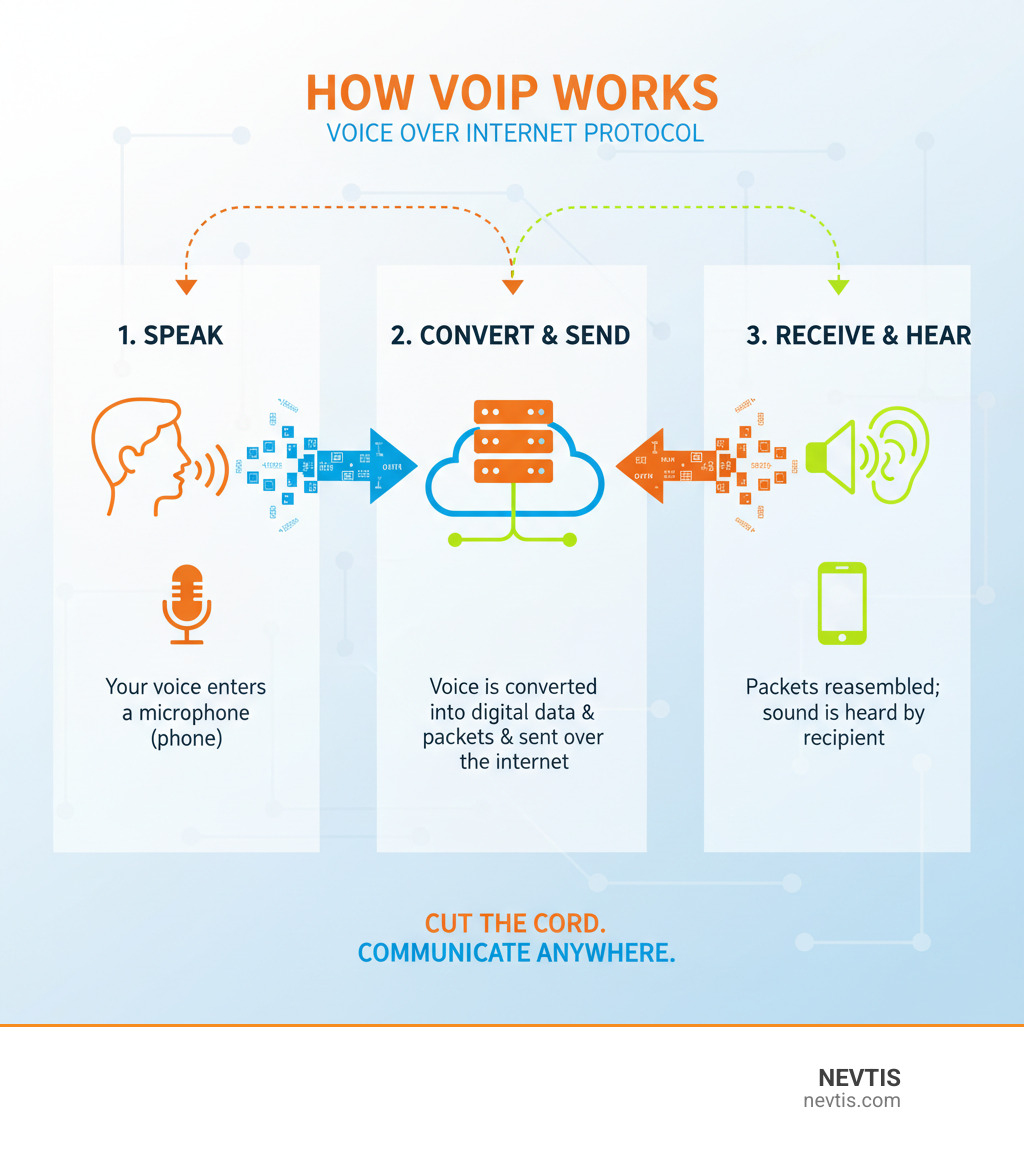
A voip online service transforms how you communicate by letting you make phone calls over the internet instead of a traditional landline. This technology, short for Voice over Internet Protocol, converts your voice into digital data packets that travel online to their destination. It’s a powerful shift from old-fashioned phone systems that relied on copper wires.
Key benefits include:
- Cost Savings: Often more affordable than traditional phone lines, especially for long-distance calls.
- Advanced Features: Includes call forwarding, voicemail-to-email, video conferencing, and more.
- Flexibility: Make and receive calls from anywhere with an internet connection.
- Scalability: Easily add or remove users as your business grows.
VoIP has revolutionized how companies connect with customers and employees, offering superior flexibility and efficiency. From small startups to large enterprises, it provides a robust and adaptable communication backbone.
I’m Juan Olmedo, a Builder turned Tech, SaaS, and UCaaS Engineer, with experience in implementing business phone systems through Hosted VoIP. My mission is to help businesses leverage advanced communication technologies like voip online service to foster growth and innovation.
Why Make the Switch? The Business Case for VoIP
For businesses across California—from Los Angeles to Anaheim—a voip online service is more than a new way to make calls; it’s a strategic upgrade that works for your business, not against it.
Traditional phone systems are known for high costs and rigid infrastructure. With a voip online service, many of these costs disappear. Services can start as low as $0.85 per month for a voice number, with calls costing around $0.009 per minute. Many businesses report saving up to 30% on communication costs after switching to cloud-based systems, especially on local and long-distance calls.
Beyond cost, VoIP offers superior scalability. Need to add five new team members or open a new location in Burbank? With VoIP, you can add or remove users in minutes through a simple online portal. The system scales with you.
Business continuity is another critical advantage. During a power outage or local emergency, a cloud-hosted voip online service keeps you connected. Calls can automatically forward to mobile phones or alternate locations, ensuring you never miss a critical business opportunity. This resilience is essential for modern business, backed by providers offering a 99.999% uptime SLA for maximum reliability.

VoIP also improves the customer experience. Intelligent call routing, CRM integration, and AI-powered tools help your team handle inquiries faster and more professionally, leading to better results.
Improved Flexibility and Mobility
A voip online service gives your team the freedom to work from anywhere while staying fully connected. Whether your team is in Pasadena, Hawthorne, or working remotely, everyone remains connected as if they were in the same office.
Our NEVTIS Plus app turns any smartphone, tablet, or laptop into a complete business phone system with over 50 enterprise features. Your team can make calls, check voicemail, and join video conferences from the devices they already use. This softphone capability frees everyone from being tied to a physical desk phone.
A unified business number ensures a professional image, as employees use their business extension on all devices without revealing personal cell numbers. Features like follow-me routing direct calls to the right person, whether they’re at their desk or on the move, so you never miss an important call. To see how we enable this, check out more info about our communication services.
Significant Cost Reduction
Moving to a voip online service can dramatically lower your communication budget. VoIP uses your existing internet connection, making internal calls between team members free, even across different offices.
With cloud-hosted VoIP, you eliminate the need for an expensive on-site PBX system and its associated maintenance contracts. The provider manages the infrastructure in the cloud, reducing your upfront costs and Total Cost of Ownership.
For businesses that communicate nationally or internationally, the savings are even greater. VoIP offers international call rates as low as $0.009 per minute, a fraction of what traditional carriers charge. Many providers offer flat-rate monthly plans with unlimited calling in the US and Canada, making your budget predictable. To see how much you could save, learn more about the real cost of a phone system.
Scalability and Advanced Features
A voip online service adapts to your business instantly. Whether you’re a startup in Orange County or an established enterprise in Los Angeles, adding or removing users is a simple process done in minutes via an online portal. You only pay for what you need.
Modern VoIP systems also include powerful features that boost efficiency. Our NEVTIS Plus app delivers over 50 enterprise features designed to make your business run smoother.
- Auto-Attendant: Greets callers with a professional message and routes them to the right department, freeing up staff.
- Call Queues: Manages high call volumes by holding and distributing calls to the next available agent, improving customer satisfaction.
- Voicemail-to-Email: Transcribes voice messages and sends them to your inbox, allowing you to scan messages quickly.
- Video Conferencing: Enables face-to-face meetings with clients and team members regardless of location.
These features are often included in standard plans, helping you present a polished, professional image to every caller.
Key Features of a Modern VoIP Online Service
Choosing a modern voip online service means investing in a complete communication hub. For companies in California and beyond, having the right integrated tools is essential for staying competitive.

A key strength of a quality voip online service is its ability to integrate with other business tools. Your phone system should connect seamlessly with your CRM (e.g., Salesforce), helpdesk software (e.g., Zendesk), and productivity tools (e.g., Google Workspace, Microsoft Teams). When a customer calls, their record can automatically pop up on your screen, providing instant context for personalized service. This saves time, improves customer satisfaction, and keeps data accurate across systems.
Core Calling and Management Features
A solid voip online service offers sophisticated features to optimize every conversation.
- Call Forwarding: Redirects calls to your mobile phone or another extension, ensuring you never miss an important call.
- Call Recording: Essential for quality assurance, training, and compliance. Many systems offer automatic recording.
- Ring Groups: Rings multiple extensions at once or sequentially to ensure calls are answered promptly.
- Interactive Voice Response (IVR): Acts as a digital receptionist, guiding callers with a menu to the correct department.
- Analytics and Reporting: Provides data on call volume, duration, and agent performance to help you make informed staffing decisions.
- Voicemail Transcription: Converts voicemails to text and delivers them to your email or via SMS. Our NEVTIS service includes AI call transcription for even faster review.
Unified Communications as a Service (UCaaS)
The voip online service landscape has evolved into Unified Communications as a Service (UCaaS), which integrates all communication channels into a single platform. Instead of juggling separate systems, UCaaS combines:
- Voice
- Video conferencing
- Team messaging and chat
- SMS and MMS texting
- E-faxing
This unified approach boosts productivity by allowing seamless transitions between communication modes. For example, you can escalate a team chat to a video call with a single click, all within one application. This streamlined workflow allows your team in Anaheim, Burbank, or anywhere else to focus on serving customers and growing the business.
The Rise of AI in Business Communications
Artificial Intelligence is making business communications smarter and more efficient. AI is no longer a future concept but a practical tool available in today’s voip online service platforms.
- AI-Powered Call Summaries: Automatically generate concise summaries of conversations, highlighting key decisions and action items.
- Sentiment Analysis: Analyzes the tone of a conversation to help agents understand a customer’s emotional state and respond more effectively.
- Task Extraction: Identifies actionable items from voicemails and sends them to your task management system.
- Spam Call Blocking: Uses AI to learn, identify, and filter out robocalls and scam attempts, reducing interruptions.
At NEVTIS, our AI call transcription service provides a real-time, searchable written record of every conversation. This improves accuracy, aids in compliance, and provides instant access to information. Integrating AI into your voip online service creates a smarter, more effective communication system.
Practical Considerations for Choosing Your Service
Choosing the right voip online service requires an honest assessment of your business needs. A creative agency in Anaheim has different requirements than a law firm in Los Angeles.
Start by considering your team. How many users do you have now, and how many will you have in two years? Your phone system must scale with your growth. Also, analyze your call patterns. A busy customer service center needs robust call queuing and analytics, while a sales team may prioritize mobile flexibility and CRM integration. Finally, list the essential tools your business uses, like Salesforce or Zendesk, and ensure your chosen VoIP provider integrates with them seamlessly.
Provider reputation is also crucial. Look for providers with proven track records, positive customer reviews, and industry recognition. Trustworthy providers are a good sign of reliable service.
Understanding the cost of a voip online service
Understanding the true cost of a voip online service means looking beyond the advertised monthly rate. Most providers use a per-user, per-month model, with prices for small businesses typically ranging from $10 to $65 per user. Plans are often tiered (e.g., Starter, Standard, Premier), with more features available at higher levels.
Some providers offer pay-as-you-go models with low per-minute rates, which can be ideal for businesses with fluctuating call volumes. Don’t forget potential hardware costs for IP phones or headsets, though softphone apps can eliminate this need entirely.
Focus on the Total Cost of Ownership (TCO), which includes service fees, setup costs, hardware, and any add-ons. The cheapest option isn’t always the best value; reliability and support often justify a higher price. Learn more about the real cost of a phone system to determine what makes sense for you.
Ensuring Network Readiness and Security
Your voip online service is only as good as your internet connection. While 5Mbps is a suggested minimum, you’ll need more bandwidth for multiple simultaneous calls or regular video conferencing. Low latency (delay) and minimal jitter (delay variation) are critical for clear conversations. Quality of Service (QoS) settings on your router can prioritize voice traffic to ensure call quality.
Security is non-negotiable. Since voice conversations are data packets, they require protection. Look for providers offering encryption standards like SIP over TLS 1.2 and AES 256-bit GCM. Multi-factor authentication (MFA) adds another vital layer of security to user logins.
For businesses in healthcare, legal, or finance, compliance with regulations like HIPAA or GDPR is mandatory. Ensure your provider meets the specific standards your industry requires. At NEVTIS, we implement stringent protocols to protect every conversation. You can find more Details on secure communication protocols on our website.
How to choose the right voip online service provider
Picking the right voip online service provider is a critical decision. Get it right, and your phone system just works.
- Reliability: Look for a Service Level Agreement (SLA) guaranteeing 99.999% uptime, which translates to less than six minutes of downtime per year.
- Customer Support: Is 24/7 support available from knowledgeable technicians? Quick, effective support is crucial, especially during setup.
- Onboarding: A smooth transition is key. Ask if the provider offers hands-on setup assistance, team training, and help with integrations.
- Compliance: If you’re in a regulated industry, ensure the provider meets necessary standards like HIPAA.
- Reputation: Check independent user reviews and ratings to gauge reliability and support quality.
- Features: Does the provider offer the specific integrations and mobile app capabilities your business needs? Our NEVTIS Plus app, for example, offers over 50 enterprise features for remote teams.
- Geographical Coverage: For businesses operating across California, from Pasadena to Newport Beach, ensure the provider offers local numbers in your key areas.
By weighing these factors, you’re choosing a long-term communication partner. We built NEVTIS to be that partner for growing businesses.
Frequently Asked Questions about VoIP Services
It’s normal to have questions when upgrading your business communications. Here are straightforward answers to some of the most common inquiries we receive about a voip online service.
Is VoIP cheaper than a traditional landline?
Yes, in almost every business scenario, a voip online service is more cost-effective than a traditional landline system. The savings come from several areas:
- Reduced Hardware Investment: Cloud-hosted systems eliminate the need for expensive on-site PBX hardware.
- Lower Operational Costs: Maintenance contracts and repair bills for physical phone lines become a thing of the past.
- Bundled Features: Advanced features like auto-attendants and voicemail-to-email are often included in standard plans at no extra cost.
- Predictable Billing: Many plans offer flat rates for unlimited calling within the US and Canada.
- Cheaper Long-Distance Calls: Because VoIP uses the internet, long-distance and international calls are dramatically less expensive.
Can I keep my existing business phone number?
Yes, you can almost always keep your existing business phone number when you switch to a voip online service. This process is called “number portability” and is a standard practice regulated by organizations like the Federal Communications Commission (FCC) in the United States.
Your new VoIP provider will guide you through the porting process, which typically takes one to two weeks. They handle the technical details, and your phone service remains uninterrupted during the transition. In addition to keeping your current numbers, a voip online service makes it easy to add new local numbers in different California area codes (like 213 for Los Angeles or 714 for Anaheim) or toll-free numbers to expand your presence.
How does VoIP support remote work?
A voip online service is the foundation of a successful remote work strategy, ensuring team members stay connected and productive, whether they’re in a home office in Newport Beach or a coffee shop in Pasadena.
- Softphone Applications: Apps like our NEVTIS Plus turn laptops, desktops, and mobile devices into fully functional business phones, allowing employees to make and receive calls from anywhere.
- Unified Presence: Team members can see who is available, on a call, or in a meeting, which improves internal collaboration.
- Full Feature Access: Remote workers get access to all office features, including voicemail, call forwarding, video conferencing, and CRM integrations, from any location with an internet connection.
- Centralized Administration: IT administrators can manage the entire phone system, add users, and change settings from a single online portal.
- Professional Image: Employees use their dedicated business extension, so customers always call a business line, not a personal number.
Conclusion: Unifying Your Communications for the Future
Adopting a voip online service is a strategic move into the future of business communication. It’s an upgrade that delivers significant advantages, from cutting phone bills to providing the flexibility for your team to work from anywhere.
We’ve explored how VoIP streamlines operations with features like auto-attendants and voicemail-to-email, while UCaaS brings voice, video, and messaging into a single, efficient platform. With the integration of AI for tasks like call summaries and spam blocking, your communications become smarter and more effective every day.
Choosing the right service means assessing your needs, understanding the costs, and selecting a reliable provider. When you get it right, the rewards are clear: lower costs, improved efficiency, and a more resilient, connected team.
Here at NEVTIS, we provide cloud-hosted VoIP phone systems designed to make your work life easier. Our NEVTIS Plus mobile app, with its 50+ enterprise features and AI call transcription, enables cost savings and seamless remote work for businesses across California. It’s time to unify your communications and lift your business. Ready to see the difference? Explore our VoIP solutions and let’s transform your business communications together.